Showing posts with label sustainable transport. Show all posts

Thursday, April 22, 2010

Thoughts on Traveling, Volcanic Eruptions and Mother Earth

Happy Earth Day - celebrate for a lifetime!


I think it is most appropriate that for the week or so preceding Earth Day that Mother Nature reminded us of her power. While travelers around the world had to deal with flight delays and cancellations as well as commerce being disrupted, the Icelandic Volcano eruption gave the world a pause. What seemed like an eternity to those stuck in airports was really just a few days in an era of constant flights when a part of the globe had a breath of no air traffic. Travel by rail swelled and some people took the cue to change their state of mind and enjoy some extra time wherever they were.

Airline companies have been complaining about how much money per day they lost and about undue flight restrictions, but all would-be travelers I have spoken with agree - as possibly inconvenient or uncomfortable having plans disrupted might be, they would rather be on the ground in one piece than 30,000 feet in the air with a frozen airplane engine - that is what most would call a no-brainer. And if the airlines are wanting to utilize the tenuous risk-assessment model, I suggest they leave that people-unfriendly calculation to the nuclear power industry (where it shouldn't be employed either), and stick to common sense as I am sure anything they have lost is still far less than what a major accident would have cost them.

In New England you learn a bit to live with the mentality of succumbing to Mother Nature. When there is a big snow or ice storm and driving is precarious, you hunker down and enjoy the respite. If you try to persevere in spite of it you usually end up in a ditch -- or worse.

Travelers, businesses and most everyone can heed the lesson and open their minds to a more creative way of looking at the world and what we are"entitled" to as a group of world citizens who feel they should be able to travel whenever and wherever they want. In this false world we have created of instant gratification, and the expectation of instant gratification, maybe we need more pauses. Maybe we should have certain weeks in the year when there is no air traffic (I can hear the screams now) and give ourselves and Mother Earth a literal and figurative breather, allowing for the possibility of changing how we treat the planet and each other.

As more of us humans lose touch with the reality of Mother Nature and her forces and are under the misguided notion that we reign supreme over the earth - think again. The Earth has been here far longer than we have and will surely be here long after we have destroyed ourselves. Whether we humans debate it, ponder it, like it or not -  the Earth does have dominion over us, not the other way around. Thank goodness.


Photo courtesy of NASA: http://visibleearth.nasa.gov/view_rec.php?id=2429

Wednesday, March 17, 2010

Cheap Bike Rental Programs Going Global!

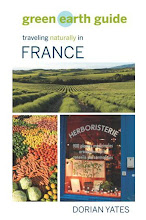
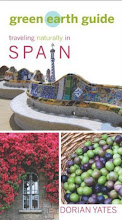
In both my books - Green Earth Guide Traveling Naturally in France and Green Earth Guide Traveling Naturally in Spain - as well as this blog, I have highlighted the cheap and wonderful city bike rental programs in Paris, Lyon, Montpellier, Nice, Nantes, Barcelona and Seville. Now I am happy to report that a successful launch of a similar program in Montreal, Canada called BIXI, is being launched in Boston, Massachusetts, Minneapolis, Minnesota and Melbourne, Australia in June. Later in the summer they hope to be operational in London, England.

BIXI operates very much like the other established city biking programs. You can pay for a day, a month or a one year subscription which entitles you to bicycle use for thirty minutes at a time for free or pay a nominal fee for additional time. For 24-hour passes you will need to pay a refundable $250 deposit. Due to the harsh winters in Montreal, BIXI bikes are available from May to November 24 hours a day, seven days a week.

The Web site gives details of bike station locations, safety and prices. Happy peddling!

Wednesday, February 10, 2010

In and Out of Barcelona By Train

Barcelona and Madrid are the two main train and plane hubs in Spain. I have found myself living on either side of Barcelona the last two winters and so have used the Barcelona trains extensively. Below are a few tricks and tips I have learned that should be useful to travelers entering or leaving Barcelona by train. 

There are two train stations in Barcelona -  Estacio de Franca in Catalan (de Francia in Spanish) and Estacio Sants. Sants is the newer station with most of the train traffic including the high speed AVE.
Franca is the old station with marble floors and a grand feeling although much smaller than Sants and with fewer tracks. The overnight trains to Paris, Zurich and Milan leave from Franca. Franca has no stores or services to speak of except ticket windows, an information desk and rest rooms.

The bathrooms have been renovated since I wrote the Green Earth Guide: Traveling Naturally in Spain and now do have toilet paper and toilet seats, but take note and get your toilet paper on the way in as it is only in the entry of the bathroom, not in the stalls.  The sinks are automated all-in-one wash and dry and the stalls now don bright pink doors. 

If you have to wait or have a layover at Franca be prepared with food especially if you have luggage, as there is nothing to eat in the station- not even a newsstand - so be prepared with reading material as well. There used to be a large café/bar at one end of the station but that is closed for renovation with no indication of when it will reopen. The left luggage (consigna) has been closed for years at Franca due to security issues. 

The station is covered but open air, so while lovely in the warmer months, it can be chilly in the winter. In the evening the one heated room is where the information area is with seven or so comfortable chairs, usually filled with travelers waiting for the overnight trains to Europe which leave between 7:00 and 9:00pm.

In stark contrast the Barcelona Sants station is a new large complex complete with shops and food options, and a metro accessible from within the station. If you have luggage you don’t want to lug around, you can leave it at the Consigna (Left-Luggage) lockers at Sants. 

There is a convenient train that runs between the two stations for 1.40 (at writing time). You need to buy a specific ticket at one of the machines for the Rodalies (commuter) trains. The trip only takes twelve minutes between the stations and is definitely the fastest, easiest and cheapest means between the two. The trains run regularly - every fifteen minutes or so. 

To buy your tickets from Sants TO Franca - go to the machines down by tracks 13-14 in the Sants station. At the machine you can choose your language and then must search for your destination (Barcelona de Franca) which will be on the second page of options. At Sants you enter the tracks with your ticket via a turnstile much like the metro so it both gains you entry and validates the ticket.

At Franca there is a machine to the right of the ticket counter near to the security checkpoint. The same thing holds true here – buying your ticket from Franca TO Sants you will have to click on the yellow “other destinations” button to find Barcelona Sants in the middle of the second page of destination options. At Franca you MUST validate your ticket in one of the machines in the hallway where security is prior to boarding the train AND you will need your ticket to exit at Sants so hold onto it. 

If you have a lot of time between trains and are not too encumbered by luggage you can take the metro to the old part of the city and stroll through the streets and up Las Ramblas stopping to have a meal or snack. The fresh squeezed fruit juices at La Boqueria market are especially refreshing for travelers. If you are starting at Franca, I would take the metro one stop to Jaume 1 and then wind my way over to Las Ramblas through the back streets. From Sants, if you don’t want to bother switching metro lines, take the green line L3 to Liceu which will let you out right on Las Ramblas.

For more information about the overnight train see the post Dinner in Paris, Breakfast in Barcelona.

Friday, December 11, 2009

Stargazing in Scotland


For those of us that have joy-filled memories of lying on our backs in a meadow gazing up at the heavens being amazed and overwhelmed by the vastness of the universe and the infinite number of stars shining down on us, you will appreciate the efforts of the International Dark Sky Association.

The Association has a program where it approves Dark Sky Parks - places where visitors can see the vast starlit night without interference from the copious light pollution that limits stargazing in densely populated parts of the world. Currently there are only four such parks in the world. There are of course plenty of wilderness areas and huge tracks of sparsely inhabited parts of the world where stargazing is possible. The Dark Sky Association is recognizing national parks or areas that make huge efforts to create a dark sky area.

The International Dark Sky Association not only promotes observing the night sky, but also works as an advocacy organization to raise awareness about the hazards of over-lighting, and working to reduce light pollution around the world. At the Dark Sky website you can find information about the best stargazing destinations as well as practical information about lighting fixtures that minimize light pollution – information you will hopefully share with your town and city officials.

For stargazing travelers, you can find three official Dark Sky Parks in the United States in Utah, and somewhat surprisingly in Pennsylvania and Ohio. 

The latest approved Dark Sky Park is in the southwest corner of Scotland, the first of its kind in Britain, located in the Galloway Forest Park. The park covers almost 200,000 acres with special roads for stargazers - most access is by foot, bikes and horses. Galloway claims there are 7000 visible stars as well as the Milky Way so on a clear night you will have plenty to observe. You can view specific information about the park’s dark sky program at their Web site. Based in Edinburgh, Scotland's own dark sky organization, Dark Sky Scotland, offers astronomy events,  a free downloadable beginners guide to astronomy, and community workshops.

Galloway Forest Park's general Web site offers downloadable guides to their events and twenty-seven walking trails, as well as information about canoeing, biking, and other activities. To reach the park, you can use the VERY useful Traveline Scotland Web site where you can plan your trip throughout Scotland using public transportation. I wish every country had such a service! 


Happy stargazing wherever you are, but certainly if you find yourself in this corner of Scotland - I wish for you many shooting stars.


Photo from NASA archive


Monday, November 23, 2009

Cheap Bike Renting In Nice


The beautiful and fun city of Nice France has started a public biking program called VeloBleu. It has 90 bike stations housing 900 bicycles accessible 24/7. As with its counterparts in Paris (Velib), Montpellier (VeloMagg), Lyon (Velo V), and Nantes (Bicloo), rental prices are somewhat unbelievably cheap, and the first thirty minutes of any bike use is included in the cheap rental fees, which are: One Day= 1 Euro; One Week = 5 Euros; One Month = 10 Euros; and One Year = 25 Euros. Bikes used for over thirty minutes are subject to a 1 to 2 Euro per hour additional charge.

You must be over fourteen years old to use the service, and use also need a cell phone, as the phone is used to lock and unlock the bicycles. Click here to access the downloadable PDF flyer with information in both French and English on how to use Velo Bleu with a map showing all the bike stations.

Enjoy bicycling on the Promenade Anglais along the magnificent turquoise water!

Monday, October 19, 2009

Segway Touring in Spain


Segways, the brain child of New Hampshire’s Dean Kamen, are two-wheeled, electric vehicles that you steer and maneuver with your body’s weight and balance. With three-speeds, the Segway can go a maximum of 10-12 miles an hour, making it quite ideal for city touring.  Segways have been adopted in many European cities as a clean, energy efficient and fun touring option. Some companies merely rent the Segways, others offer tour groups with all participants riding Segways. Most rental and touring companies require users to partake in a 15-30 minute Segway training prior to use.

Please check each Web site for specifics as they vary per company. Most have a weight range of 100-220 pounds per person and some ask riders to be at least 15-18 years of age. Duration of tour or rental and price vary as well from one to three hours and from 35 to 60 Euros. Some companies will offer special theme tours outside of the cities like in natural parks and vineyard touring.


Segway Renting and Tour Companies in Spain include the following:

Madrid, Leon, Oviedo and Santander: http://www.citysegway.es/english_index.htm
Madrid: http://www.madsegs.com
and Bicycle and Segway rentals: http://www.urbanmovil.com
Barcelona: http://www.barcelonasegwayfun.com/home.htm
and http://www.barcelonasegwayglides.com
Girona: http://www.sobrerodes.cat/homesbrs.html
and http://www.segwaytours.cat/en_index.php
Valencia & Castellon: http://www.segwayvalencia.com
and Bicycle and Segway rentals & tours in Valencia: http://www.valenciabikes.com/es/segway-tours
Malaga: http://www.segwaymalagatours.com

Tuesday, September 22, 2009

European Mobility Week- Promoting Sustainable, Green Transit

Even though Europe is light years ahead of the United States in sustainable transportation, sadly the car still ranks by far as the most used method of transport. For the past eight years European Mobility week, (http://www.mobilityweek.eu) promoting sustainable transport - walking, biking, train and bus – has worked to spread the word about the benefits of non-car transit. The week runs every year from September 16-22 and there are over 1600 cities and towns participating, with Austria and Spain at the top of the list of countries with the most participating towns. This year’s campaign will conclude Tuesday September 22 with Car-Free day.

Some cities already use a high percentage of sustainable transit including Copenhagen, Denmark and Gronningen, Holland with the highest level of bicycle usage comprising 55% of the principal transportation mode. Amsterdam, Holland and Munich, Germany clock in at 40%, with other cities using less, but climbing in numbers. On the low end, in Seville, Spain, bike transport makes up only 8% of the main method of transport, but the city is working on promoting bike use including their cheap Sevici bike rental program.

In Madrid, not known for being a bike friendly city, Trixi (http://trixi.com) bike rental is offering bikes at 1 euro/hour. ConBici is a Spanish organization promoting bike use throughout Spain (http://www.conbici.org). At their web site you can get biking information for over thirty cities in Spain. ConBici is also the driving force behind increasing the number of trains that allow bicycles.

I have found bike rentals to be cheap and easily accessible throughout French and Spanish cities so as a green traveler you can make every day car-free day when you visit these countries.

Monday, September 14, 2009

Biking in Spain


After the Tour de France finished this summer with a Spaniard winning for the fourth year in a row, NPR ran a story on July 29th about biking in Spain and the correspondent, based in Madrid, reported that people in Spain hardly ever biked to work or to run errands, even though Spain produced the last four Tour winners.

Having grown up in New York City – Manhattan to be exact – I know how easy it is to judge (and mistakenly so) a country by its largest city. In any event, while Madrid is not considered to be at all a biker-friendly city, Spain’s next three largest cities – Barcelona, Valencia and Seville – all are, and people in these cities make good use of their bikes for errands, commuting, leisure and sport. Barcelona and Seville both have incredibly cheap city sponsored bike rental programs (Bicing and Sevici), and Valencia has bike shops on what seems like every 10-20 blocks.

There are of course two big issues in Spain for bikers – sharing the road with pretty crazy drivers, and security. Bike rental shops tend to rent bikes with two! locks included and instruct you on how to lock your bike to make it fairly theft proof. I overheard one potential renter exclaim, “They would steal the seat?” and the bike expert replying, “they will steal anything… and everything if they can.”

There is nothing one can do about the crazy drivers, except be careful and stick to bike lanes and sidewalks, and observe the lights.

If you are planning on using a bike for getting around – take note. In Valencia, bikes are only allowed on the Metro during certain days and hours – all day Sundays and holidays they are allowed as well as AFTER 2pm on Saturdays. Otherwise they are not allowed and if you do bring the bike on during a weekday you will find your self being escorted out of the Metro by the Metro policia – I have seen it happen.

There is great biking to be had in Spain for all levels and for all purposes, and you will definitely not be the only one out if you choose to make it your transport choice.

Wednesday, June 10, 2009

Green Low-Carbon Transit Travel Options


If you are traveling in New York City, Boston, Chicago, Washington, DC, San Francisco, or London, you can find directions and navigation help at www.hopstop.com. Similar to Google-maps, but specific to rail/subway, bus and walking in the above six cities, Hopstop.com will let you enter your starting and destination addresses and provide you with the time, distance and routes by public transit or foot. An incredibly useful tool, we can only hope that hopstop.com will continue to add more cities.

The New York City MTA (Metropolitan Transit Authority) promotes hopstop.com with facts such as that every full bus keeps up to 40 cars off the roads, and every full train-car keeps between 75-125 cars off the road!

If you are looking for detailed information about what might be the lowest carbon options for vacations this summer, check out the report and guide produced by the Union for Concerned Scientists, Getting There Greener, where they compare the best travel options depending upon number of travelers, distance traveling, and type of transit. The link: http://www.ucsusa.org/clean_vehicles/solutions/cleaner_cars_pickups_and_suvs/greentravel/getting-there-greener.html will let you choose the full report, a summary, or a quick reference chart.

Traveling by public transport not only allows you to go lightly and reduce your carbon footprint, but it also sheds interesting insights into the pulse of the city you are visiting, and I have found usually produces funny travel tales, so let hopstop.com help you with plotting your course.

Tuesday, March 3, 2009

Heading West

I much prefer the train to the bus and the little, narrow-gauge train I am on, chugs along, designed as a local route to haul workers and minerals. It is a wonderful way to see the countryside as the train often goes through areas with no roads. My feet are happy for the rest of the many hours long ride as they are sore and one has a blister the size of my thumb from hours pounding the pavement scouting out the health food stores and sites of my destinations.
The woman at the Bilbao Post office thought I was a pilgrim on the road to Santiago as I was donned with my double-pack look, one on the front and the other on my back. I let her believe this as I am on my way to Santiago and it will take me two days to reach it, and then will do my own walking pilgrimage at the end of the world, in Fisterra. In her brief kindness I caught a glimpse of the camaraderie, solidarity (a word the Spaniards love and use a lot), and compassion that camino travelers encounter all the time.

The train I am on follows various camino routes. This is mountainous terrain (I am told that Spain is second only to Switzerland in most mountainous country in Europe) and I am most grateful to not be on a bus, which even if you are not prone to car-sickness, can make you woozy as they twist and turn around the sometimes hairpin curves of the mountain roads.
The train snakes its way through the Picos de Europa mountains, farmland, forests, with tiny glimpses of the ocean. Makes you feel as though you could be walking or biking through the bucolic setting.

So I am on the regional FEVE trains making my way from Bilbao west to Santander, through the regions of Cantabrias and Asturias, referred to as the "green" coast because it is so lush, with my final destination in the region of Galicia in northwestern most Spain.

Sunday, November 16, 2008

a little bit more Berkeley

The Fourth Street Shopping District is in a corner of the city where upscale, boutique stores flourish and some even have outlet-like offerings. Ironically, amidst the high-end retail stores, a stone’s throw up an alley street, is the SEVA Foundation, dedicated to “selling” gifts of service to help people in need around the globe. Since 1978 SEVA has helped indigenous people with health care and environmental and social justice issues.

The city buses in Berkeley cost $1.75. While the machines take bills, they do not give change, so if you are in a pinch with two dollars, but no change, you can still take the bus, but will have donated .25¢ to the transit authority. As far as I am concerned that is a cheap remedy for the anxiety of trying to find someplace to give you change. FYI – the buses in San Francisco are 1.50 and the same applies, although I was lucky enough to have someone behind me with 1.50 – so I put my 2 dollar bills into the machine – she put her 1 dollar bill and gave me the .50¢ change – an easy solution suggested by the bus driver who must have lots of experience with creative bus fare financing. The BART metro cards are not usable on the buses.

http://www.seva.org

Tuesday, January 29, 2008

A Roman Day, but no Italians


I headed to the world famous Roman Aqueduct, Pont du Gard, midday, and after my other escapades was watching for the right bus stop carefully. Fortunately there were a number of people with the same destination and the bus driver very kindly turned around and announced that it was the Pont du Gard stop when he realized none of us were disembarking – good thing as who would have guessed that this world-famous site rates an unmarked bus lane on a highway rotary. We all got off and looked around: no signs, no maps, no arrows – you have to love the French. An Australian couple and myself started walking towards the direction we suspected was the right one and the Koreans followed. Sure enough, down the side road there was a huge sign saying “Site Pont du Gard”. I might further add that since it is off-season, you can take a bus to Pont du Gard from Avignon, but not really back since the only bus returning leaves 20 minutes after you arrive which even the Avignon bus station attendant said was too short an interval since it is a 10-15 walk from the bus “stop” to the Pont du Gard. So my itinerary was Avignon to Pont du Gard, then Pont du Gard to Nimes, returning to Avignon from Nimes where there is regular bus and train service to Avignon. There was only one bus from Pont du Gard to Nimes today, but it left more time to tour the site than the bus back to Avignon.
Pont du Gard has been designated a UNESCO World Heritage site. It originally spanned over 1000 feet, but some of the arches are gone so it is a little shorter now, but still quite impressive. Standing about 150 feet high, the bridge was part of an aqueduct that brought water from a spring in Uzes to Nimes about 30 miles away. According to the tourist information, the bridge, completed in AD 52, took 1000 men and 50,000 tons of stone to build it (www.pontdugard.fr).
I could tell by the expansive parking lot and walkways that the tourist area around Pont du Gard had been designed for a sea of summer tourists. I could not only imagine the crowds, but also the beating heat. Other than the limited bus schedule, and the gift shops being closed (no great loss), the off-season is a perfect time to visit the monument. There were so few visitors it was down right serene. I was able to hike up a stone-stepped path and meet no one heading up or down. Down by the emerald green water there was only one couple taking in the sun and magnitude of the site.
The cool thing about the site – besides seeing first hand the staggering brilliance of the Roman architects and builders – is that a newer section of the bridge has been built to match the old one, so you can walk across the bridge right next to the ancient aqueduct, getting great views and a close up of the original.
Nervous about the French bus system, I curtailed my visit and walked back to the bus “stop” so I would be there in case the bus came early. I read and reread my information, and had especially asked the Avignon bus-information attendant if I picked up the bus to Nimes at the same place that the Avignon bus dropped me off and she assured me that indeed it was the same stop. The bus was not early, but I was nervous about the stop. There was a schedule inside a glass box with condensation on it, making it hard to read, but it did indeed give the schedule to Nimes that I held in my hand. Somehow I was still nervous. The road signs made me think that the bus would not be coming in the direction of this bus stop. I looked across the road, and sure enough here was a bus with its electronic sign saying “Nimes” stopping not only across the highway, but on the other side of the rotary. I basically stopped traffic and ran across the highway, waving my arms frantically at the bus, knowing that if it didn’t stop I would be stranded on this highway until tomorrow. Thankfully, the bus driver was a kind soul, and he stopped in the middle of the road to let me on. Honestly! How hard would it be for the French bus system to put a sign on the bus stop? Especially the Pont du Gard bus stop!
There and then I decided I would take the train from Nimes to Avignon, not the bus.
It was a short ride to Nimes, a major Roman city in the day. Nimes has two very well preserved Roman buildings. The Arena, which holds 24,000 people, was built in the 1st century for gladiator events. It has been partially restored so that it can be used for present-day bull-fights. The Maison Carree Temple is one of most intact buildings from the Roman Empire and dates to something like AD 4. History oozes from all these sites with deeply worn stone steps and weather beaten walls.
I toured Nimes quickly and took the train back to Avignon – not only did they announce the station stops, but it took half the time of the bus and cost half the price.
At 8pm I made my way to the old Avignon theater in the large square below the Palais du Popes. It was a one-night run of the opera La Boheme, which seemed appropriate to see while in France. My 20 Euro ticket got me a seat in the bleachers way at the top of the theater. The seats in this section are not numbered and are just carpeted steps, so it is first come, first choice, which makes a huge difference since at least two thirds of the seats have very limited views of the stage. I had arrived as soon as the doors had opened so from my seat I could see over half of the stage. There was camaraderie amongst those of us with limited views, as we craned our necks and backs to see the action – a great French experience. Bon Soir from Avignon.

Friday, January 25, 2008

The Magic of Lourmarin


I started what would be an almost perfect day unwrapping my Banon cheese. This is divine stuff – like brie, but no bite. I had this with the last of my rose-smoked salmon on my moist sans-gluten bread – pure heaven.
I got on the bus to Lourmarin - where I need to point out for the rest of the story – I held the bus schedule up to the bus driver so there could be no confusion that I was going to Lourmarin and paid for my ticket (you buy your tickets on the buses here). The bus made stops in a number of cute and interesting villages. I looked at my watch and knew we must be approaching Lourmarin. Sure enough – I saw the road sign and the bus turned and headed up a hill, which I presumed was into Lourmarin as the street sign said the name of one of the streets I was to look for. I disembarked and the driver gave me a broad smile and waved. I looked around for the tourist information office to get a map. I started following the signs but they seemed to be sending me much farther than what I had understood would be the case. I found myself in a maze of tiny streets and by some miracle arrived at the tourist office. A friendly woman greeted me and I asked for a map. She said, “For here?” and I said, “Yes, for Lourmarin.” A perplexed look crossed her face and she said, “This is Lauris.” Well you can imagine that the “merde” was next!
I had gotten off at the wrong damn village and the bus driver must have chuckled about this the rest of his day. I was trying to get to Lourmarin for their morning market which closes at 1pm and then meet some friends who run a B&B there for lunch. It was now 11:40. The taxi would take 10 minutes to arrive if I was lucky and set me back 12 euros. I decided to hoof the 5km to Lourmarin.
The woman was a little surprised by my choice but showed me on the map which road to take to the main road to Lourmarin and off I went. I tried not to be too cranky about this unexpected hike and instead enjoy the sunny morning as sweat poured down my torso.
I arrived in Lourmarin and found the market with about 20 minutes to spare. I bought incredible, freshly made tapenade, and an olive marmalade – out of this world (the vendor was offering me samples of every delectable item he had.)
I wound my way through the exquisite old stone village and found my friends – just as they were giving up on me.
We ate a delicious lunch of Aoli – a traditional Provencal dish with cooked vegetables and fish served with fresh garlic mayonnaise - some local red wine, and lots of talking as I had not had a full conversation with anyone since I left Switzerland.
After lunch I toured the beautiful and very special Les Olivettes Bed and Breakfast villa with individual apartments. For pictures see the website: www.olivettes.com . Les Olivettes is within walking distance of the village center, but is across the main road and has lovely grounds filled with gardens and olive trees – hence the name. In fact, you can come for your stay during olive harvest time and help pick the olives. Les Olivettes is not a budget accommodation, but rather a reasonably priced luxury accommodation, beautifully appointed.
My generous hosts then took me on a tour of two smaller, but equally magnificent nearby villages – Cucuron and Vangines – both filled with old stone buildings and much charm. On the drive back to Avignon we took the road through the Luberon, passing the Chateau Canorgue (Rte de Pont Julien, Bonnieux, Vaucluse), an organic and biodynamic vineyard.
A # 10 of a day even with getting off in the wrong town.