Showing posts with label Walking. Show all posts

Monday, January 31, 2011

Wanderweg—The Magic of Walking in Switzerland

The Wanderweg (W’s are pronounced like V’s in German) is the term used for the more than 31,000 miles of walking trails in Switzerland. Walking the Wanderweg is a common Swiss past-time and it is quite usual to see Swiss hikers of all ages on the trains heading to or from their hikes with rucksacks and walking sticks in hand.

The Wanderweg is posted with orange signs to keep you on course and every so often there will be directional signs with estimated time and kilometer distances. Consider that while many of the routes on the Wanderweg are roads of various sizes, there are also numerous stretches that are mere foot- or sheepworn paths through a field or pasture, or even a lawn!

Take your time. Never be in a rush when starting out on a new Wanderweg route. Much of the fun and charm have to do with the adventure of making your way through the beautiful landscape. Another wonderful aspect of the Wanderweg is that it is not just for recreation and sightseeing. The Wanderweg is practical. If you have figured out your route—you can walk to your destination be it clinic, store, attraction—no need for cars, or public transportation. Or for variety you can take advantage of all options, walking one direction and taking public transport for your return, or walking both ways, but taking different routes. A word to the wise—be prepared for steep walking—both uphill and downhill—Swiss walking is not for the weak-kneed.

One of the pilgrimage-walking routes to Santiago de Compostela (St. James Way or Jacobsweg in German) in Spain goes through the Fribourg area of Switzerland. See the Swiss site for Santiago routes in English.


Excerpted from the Green Earth Guide: Traveling Naturally in Switzerland

Saturday, December 18, 2010

Traveling Green in Switzerland—5 Must-Dos

1) Walk on the Wanderweg 
With more than 30,000 miles! of marked walking trails, Switzerland is supreme for travelers who like to tour on foot and take in the local beauty
2) Partake in a Thermal "Bad"
Hot mineral springs are numerous throughout Switzerland. Enjoy the healing waters while soaking in the indoor and outdoor baths.
3) Use Public Transportation
Take advantage of Switzerland's efficient and prolific public transport—trains, buses and gondolas abound— no excuse for not traveling green in Switzerland.
4) Eat Organic Food
Biodynamic and organic farms are plentiful in Switzerland. Visit farms and vineyards directly or purchase products at farmer's markets and health food stores. And don't forget the chocolate!
5) Explore Natural Health
You will find copious natural and alternative health care in the hills and valleys of Switzerland. Ayurveda, anthroposophy, massage, naturopathy, homeopathy, herbs and more.

Monday, April 5, 2010

A Piece of Magic Ancient Forest

I learned about some of the last remains of the once bountiful European primeval forest not from a guidebook or fellow traveler, but rather from the book, The Zookeeper's Wife - an excellent read. The Białowieza Forest, originally all within Russian borders, now lies partly in Belarus, known there as Belovzhskaya Pushcha,  and partly in Poland almost due east of Warsaw. Fortunately for everyone the forest was designated a UNESCO World Heritage Site in 1979 and about fourteen years later as a Biosphere Reserve.

The protected forest covers almost 38,000 acres. Tree lovers and huggers will especially appreciate the grandmother oak trees some over 800 years old and reaching 150 feet tall! Interestingly this patch of forest has alternated through hundreds of years of history between a protected forest reserve and a hunting ground. Most of the wild animals were hunted to near extinction, but now many of the indigenous animals - wolf, lynx, peregrine falcon- can be found at the park zoo including the Wisent (pronounced Vizent) - the European version of the American Buffalo which now has a protected reserve within the park.

To help preserve this treasured plot of forest, tourists are not allowed into the deepest part of the reserve - only researchers are allowed access. Guided tours are available to certain areas. But there are routes in the Hwozna Protective Unit for walking and biking (skiing in the winter), as well as special guided tours through some of the more restricted areas of the park - the Orłówka Protective Unit. All must be arranged through the park.

The Park Website, fortunately with an English version, offers extensive  information about the flora and fauna in the park, museum opening times, entry fees, as well as details about the 105 guest beds available in the adjacent Palace Park.

The Website also instructs you in how to behave should you come upon one of the massive Wisents in your touring - most importantly remain calm (if you can) while you marvel at these incredible creatures and majestic, wise trees.

Białowieza National Park 
17-230 Białowieza, Park Pałacowy 11, Poland 
Tel: (+48) 85 682-9700 or 85 681-2306 
E-mail: bpn@bpn.com.pl; Web; You can reach the park by train and bus.

The Zookeeper's Wife, Diane Ackerman. Norton 2007

Wednesday, March 31, 2010

Kneipping in Switzerland

The health-conscious Swiss have embraced the water cure and health philosophy of German Priest Sebastian Kneipp (1821-1897).  Kneipp (pronounced k-nipe) understood the connection between mind and body and promoted the use of medicinal herbs, exercise, a whole foods diet, a healthy mind, and his most enduring legacy –hydrotherapy. Kneipp’s book, My Water Cure, was published in 1886!

Walking barefoot through water or on wet grass, stones, or snow was one of Kneipp’s simple yet effective techniques. A thoughtful and observant man, Kneipp saw the benefits of his”cure” but also understood that each person required variations and degrees on his theme.  

There are numerous Kneipp routes and spas offering Kneipp "cures" throughout Switzerland (and Germany). At the numerous thermal baths around Switzerland you will find shallow cold water pools often between the large warm pools that you are meant to walk trough a-la Kneipp to get your circulation and lymph flowing.

You can go Kneipping or walking on a Kneippweg. In Blitzingen, south of Bern and Luzern, you can walk the NaturKneippweg through streams and meadows - it is considered to be the longest natural Kneipp path in Switzerland. 

In Grachen, a village in the Matterhorn Valley, there is a public Kneipp "garden" about a fifteen minute walk from the town with stone lined pools designed for Kneipp leg and arm immersions in cool (well let's face it- cold) water. Two hotels in the area specialize in Kneipp cures and can help you develop your Kneipping skills. These are Hotel zum See with access to the Kneipp garden as well as their own spa and the Hotel Stutz, a dedicated no-smoking hotel.

Happy Kneipping!


Monday, November 23, 2009

Biodynamic Farm and Farmstand in Appenzell Switzerland


If you are in Switzerland, a visit to the Appenzell canton of Northeast Switzerland, a region known for its beautiful farm land, progressive health laws, and rural traditions, is highly recommended. There are countless farms and fabulous “Wanderweg” hiking trails throughout. A favorite farm and farm store is in Gais, but if you don't know it's there, you wouldn't be likely to find it.

From the city of St. Gallen, you take the Appenzeller Bahnen, a small, red train which, as its name implies, travels through the Appenzell canton with trains running about every 30 minutes. Take this train for about half an hour to the town of Gais. (If you are in Teufen, Gais is about half-way to Appenzell on the train.) Once off the train, you will walk about 1 mile. Cross Schulhausstrasse and walk along Zung St., then cross Stossstrasse and slightly to the right of where you have been walking will be Kehr St. Walk on Kehr for about one-quarter to one-third of a mile and take a right onto Bommes Road – looks more like a driveway - within 20 yards or so you will walk into the yard of the Biodynamic Hofladen Farm where there is a little farm store. Biodynamic Hofladen Farm, Bommes 3, Gais, Tel: 71 793 37 85; www.hof-bommes.ch

The store’s entry-way has fresh organic produce delivered on Fridays. Further inside you will find a mini-health food store with organic and free-trade food and treats, including farm fresh, biodynamic dairy products from the Hofladen Farm. There is nothing quite like farm fresh yogurt in a glass container – seems from a lost world - perfect and delicious (my apologies to non-dairy eaters.) Fresh, organic spelt bread, made from spelt grown a few towns over (a bakery that makes their own spelt pasta, pastries, and bread - directions on their Web site), is delivered Tuesday, Fridays and Saturdays. On those days the Hofladen store is open from 9:00 to 11:30 am and then again from 3:00 to 7:00pm. Every other day it is open from just 6:00 to 7:00pm.

Not much English is spoken, but everything seems to get across just fine. Two tips: In Switzerland (and many other places in Europe), when buying fresh produce you are responsible for weighing and pricing it. There is a number by the name of the item – e.g. Red Cabbage #62 – take your red cabbage over to the scale (somewhere in the produce area) and weigh it – you will need to punch in that number. A sticker will spit out with the weight and price that you apply to the bag or item. In lower-tech establishments, you may have to write it on the bag.

Also, remember to bring your own bags – many stores either do not have bags or charge for them, and often they are flimsy – so just get used to having a stash of canvas bags rolled up in your daypack.

The farm belongs to the Langenegger family. The grandmother, Lilly Langenegger, is a local famous artist who writes children’s books with beautiful illustrations of traditional Swiss rural images and Appenzeller farm life. The books are available in German, English and French. Pictures and purchasing information are available at the publisher Web site (in German, but translatable).
Enjoy.

Tuesday, July 14, 2009

Bastille Day and Tour du France The Green Way in Limoges, Gueret and more

Happy Bastille Day!
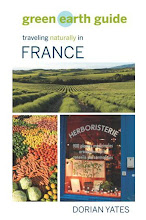
You can hear the podcast to New Hampshire Public Radio's Word of Mouth segment on The Green Earth Guide: Traveling Naturally in France at http://www.nhpr.org/node/26019.

I am listing here the details on some of the tips I gave on the show.

The Tour du France route on July 14th runs from Limoges (in the Limousin region) to Issoudun (in the Centre region) - 194.5km (about 120 miles) - right through the center of France. See the Tour du France route at www.letour.fr

Health food stores in the area include:
In Limoges (87 Haute Vienne dept):
La Vie Claire, 9 rue Lansecot, 87000 Limoges; Tel: 05 55 307 671
Bonne Terre affiliated stores:
Planete Nature, 15 rue Hoche, 87000 Limoges, Tel: 05 55 796 997 (off Place Marceau)
Rayons Verts, 11 rue Clouet, Limoges, Tel: 05 55 439 583

In Gueret (Creuse # 23):
La Vie Claire, 4 rue de l’Eglise, 23000 Gueret, Tel: 05 55 528 547

In Chateauroux:
Castel Bio, 15 rue Joseph Bellier, Chateauroux, Tel: 02 54 089 144
Espace Bio, Centre Commercial St Jacques, 36000 Chateauroux

There are markets in Issoudun, Bourges, Gueret and other towns. In Gueret market days are Thursday and Saturdays.


Places to lay your head at night include the following "green" lodging:

Holiday Tipis in France has six tipis powered by solar electricity. Open from May 1st to August 31st, they serve local foods for breakfast included in the tipi charge, and optional dinners three evenings a week. Stays range from three to seven days and prices run from 170 to 350 euros per tipi depending upon length of stay. Located about fifteen minutes from Gueret. Holiday Tipis in France, 7 Folbeix, Ladapeyre, Creuse, France 23270; Tel: 05 55 809 026; Email: info@vacanesdetipienfrance.com; Web site: www.vacanesdetipienfrance.com

3 Place de Sarbres is a vegetarian bed & breakfast in a renovated 18th century house in the town of Felletin about 1hr 45 minutes East of Limoges and one hour south of Le Creuse, considered the French Lake District. The apartment ranges from 189-252 euros per week.
Bed and Breakfast rooms are 50 euros a night - vegetarian meals are extra. In Felletin the water comes from the mountains so it is like bottled water from the tap... also there is a micro brewery in the town. www.3placedesarbres.com; info@3placedesarbres.com; Tel: 05 55 665 229

Northeast of Gueret you will find Le Petit Pauliat, a rural gite rented by the week from Saturday to Saturday in a beautiful rural setting with nearby Le Petit Pauliat, 4 Pauliat, 03380 Treignat; Tel: 04 70 070 885; Email: info@pauliat.com; Web site: www.pauliat.com.

For the thermal baths....
Evaux-Les-Bains is a small spa and thermal bath town east of Gueret. More information is at the town web site: www.ot-evauxlesbains.com; and at the Web site for the baths: www.evauxthermes.com

Walking routes include:
One of the Routes to Santiago de Compostela in Spain (Route of St James), runs through the region of Limousin, starting in Vezelay and heading south of Bourges towards Limoges and St Leonard De Noblat - GR 654. ANother walking path is GR 3 - see the Website for both of them at: http://www.ffrandonnee.fr/itineraires/ideesRandos_selection.aspx - click on the map for the area you want.

Parks: Issoudun has city parks and sites
Regional Natural Park is in Brenne just west of Chateauroux between Limoges and Bourges - Web site: http://www.parc-naturel-brenne.fr/parc/ou/index.html

Excursions:
90 km south of Limoges the town of Brive-la-Gaillarde is home to a famous market where you can find local specialties including walnuts, mushrooms, truffles, apples and violet mustard. The market is held on Place du 14 Juillet and Place de Lattre de Tassigny on Tuesday and Saturday mornings from 8am to 12:30pm.

The Limousin region was home to a strong contingent of the French Resistance including the Maquis guerilla resistance fighters who worked to combat the Nazi controlled government in Vichy. In Brive-la-Gaillard you can find the Musée de la Resistance et de la Deportation Edmund Michelet (The Resistance & Deportation Museum), with memorabilia, artifacts and photographs from World War II and the French Resistance. Musée de la Resistance et de la Deportation Edmund Michelet (The Resistance & Deportation Museum), rue Champanatier, 19100 Brive la Gaillard; Tel: 05 55 740 608. Open every day except Sunday and holidays from 10am to 12pm/2pm to 6pm with free entrance.

Organic and Bio-Dynamic Vineyards:
Biovidis is a biodynamic vineyard in Amboise, Indre et Loire - www.biovidis.com

Here's to Liberty, Equality, and Fraternity, not just for the French, but for the planet!

Thursday, October 4, 2007

Cinque Terre


Cinque Terre, Italy...
I sort of hate to write about Cinque Terre but thankfully it has its own self-protecting mechanism in place – allowing only so many people at a time into the area so as to minimize the human impact, controlled by a limit on ticket passes sold.

Cinque Terre sits on the coast of the Ligurian Sea - the northern Mediterranean in the western upper curve of the Italian coast. It is a UNESCO World Heritage site which affords it recognition and protection as a unique and extraordinary spot on earth. The five villages that make up the Cinque (five) Terre (land/villages) are Rio Maggiore, Manarola, Carniglia, Vernazza, and Monterosso spread along 12 km of spectacular Mediterranean coast. The villages are built into the hill/cliff-sides and footpaths (sentieri in Italian) connect the villages as well as an underground train. Cars can only access the upper parts of some of the villages. Maps are available from the Parco Nazionale delle Cinque Terre - www.parconazionale5terre.it - as well as the "Carta" - ticket you purchase at the local train station which allows you to walk on the footpaths and ride the train between the villages. A word of caution - do not plan a tight schedule - every train was between 15-30 minutes late when we were there.

There are a number of path options - along the coast,or up through the olive orchards, or through tiny paths between grape vines. Be prepared for trail closures – mudslides, downed trees – nature at work. Whatever trail you take, be assured that there is no shortage of photo opportunities no matter the weather.

The combination of the ancient, the necessary and the modern is breathtaking – dry stone walls, terracing, bountiful food, the brilliant turquoise mixed with olive leaf silver, the yellow of the lemons and the pastel rainbow of the buildings stacked into the hillsides all illuminate the magnificence of humans and nature together - rather than spoils, riches on every level.

While we were there - we had to make an impromptu route change as there had been a mudslide on our path, closing the trail. Our unmarked path brought us to the back of one of the towns where we serendipitously found a wonderful, unadvertised hostel (Ostello in Italian) - www.hostel5Terre.com - off the beaten path where we could bed down for the night at 17 Euros per person and for an extra 5 euros have a large bowl of pasta and organic local basil pesto. It doesn't get much better than that!

In Manarola village there is one of the best smoothie and fruit drink places I have ever found - we had one that was apple,cardamon and lemon - divine! and another that was mandarin, melon and lemon. They also had drinks with an almond milk base. Everything we had was delicious and with wonderful combinations of flavors. They are up the hill on the right - can't miss them - and don't.

The local people were open and friendly. In a little ceramic shop in Manarola, run by people who have lived there all their lives, I purchased a huge, round platter hand-painted in pastel colors depicting each of the five villages. They were so delighted that I was buying the huge platter that they gave me 2 other hand-painted dishes - all of which I have hanging in my kitchen at home.

The official, local organic Pesto is made with the Parco Nazionale label on it and is incredible - made with local lemons, olive oil, and basil (basilico). Remember to buy a few jars to savor once you are home.

Cinque Terre is heaven for the eco-conscious traveler - you will not want to leave.