Busy, busy, busy here producing The Essential Green Travel Guide series of Apps. Green Venice is live and selling swiftly!
Next up is Vermont Eats—a tour de force of the great, green, groovy food scene in Vermont. Vermont Eats has over 400 entries, 1300 photos, all searchable by price, region and type of business including farmer's markets, artisan cheeses, farm-to-table restaurants, micro-breweries, pizzas, gluten-free foods, vegetarian options, organic farms, health food stores and about thirty more categories—all easy-to-find with built-in Google maps.
Vermont Eats will be live within two weeks so stay tuned for the launch date. A must-have for both residents and travelers—you won't want to leave home without this App!
Showing posts with label Biodynamic. Show all posts
Friday, September 9, 2011
Monday, January 10, 2011
Slow Food Spain
Last week, "alive" food. This week slow….. and not as in eating snails (even though that is the Slow Food logo) and sloths, but rather, slow as in the promotion of whole food meals prepared fresh from local and seasonal foods.
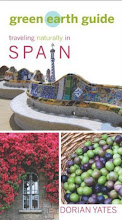
In Spain, the Slow Food Farm-to-Table project, called Km 0, certifies restaurants serving local, organic and indigenous foods that have come from farms less than 100 km (62 miles) away. Close to sixty restaurants around Spain have been recognized as Km 0. The highest concentration of Km 0 restaurants are in the Catalonia and Basque regions. The rest are scattered around the country. A couple are listed specifically in the Green Earth Guide to Spain—Kimpira in Valencia and Gaia in Sevilla.
Founded in Italy twenty-two years ago, the Slow Food movement mission is five-fold—to defend food biodiversity, safeguard the environment, advocate sustainable agriculture, protect small producers and their communities, and foster the gastronomic traditions of the world. Within that broad purpose, Slow Food has many projects including Farm to Table/Km 0 and the Ark of Taste. For restaurants in Spain to be accepted in the Km 0 program they must serve at least 5 dishes on their menu made avoiding GMO foods and with a minimum of 40% ingredients from local producers and 60% from foods that are organic or identified in the Ark of Taste project. The Slow Food Foundation for Biodiversity Ark of Taste project catalogs and promotes indigenous foods at risk of extinction. More than 900 foods from fifty countries have been identified so far. In Spain this includes seventy-nine foods—some olive oils, olives, fruits, vegetables, herbs, cheeses, meat, fish, grains and wines. Restaurants are reviewed annually to make sure they are maintaining compliance with the Km 0 requirements.
Thanks to Slow Food España for administrating the Km 0 project and for providing the list of Km 0 participating restaurants. To find the Spanish restaurants approved as Km 0 visit the new 2010-2011 list of restaurants, organized alphabetically by city:
http://cocineros.slowfood.es/2010/12/09/restaurantes-km-0-edicion-2010-2011/
In Spain, the Slow Food Farm-to-Table project, called Km 0, certifies restaurants serving local, organic and indigenous foods that have come from farms less than 100 km (62 miles) away. Close to sixty restaurants around Spain have been recognized as Km 0. The highest concentration of Km 0 restaurants are in the Catalonia and Basque regions. The rest are scattered around the country. A couple are listed specifically in the Green Earth Guide to Spain—Kimpira in Valencia and Gaia in Sevilla.
Founded in Italy twenty-two years ago, the Slow Food movement mission is five-fold—to defend food biodiversity, safeguard the environment, advocate sustainable agriculture, protect small producers and their communities, and foster the gastronomic traditions of the world. Within that broad purpose, Slow Food has many projects including Farm to Table/Km 0 and the Ark of Taste. For restaurants in Spain to be accepted in the Km 0 program they must serve at least 5 dishes on their menu made avoiding GMO foods and with a minimum of 40% ingredients from local producers and 60% from foods that are organic or identified in the Ark of Taste project. The Slow Food Foundation for Biodiversity Ark of Taste project catalogs and promotes indigenous foods at risk of extinction. More than 900 foods from fifty countries have been identified so far. In Spain this includes seventy-nine foods—some olive oils, olives, fruits, vegetables, herbs, cheeses, meat, fish, grains and wines. Restaurants are reviewed annually to make sure they are maintaining compliance with the Km 0 requirements.
Thanks to Slow Food España for administrating the Km 0 project and for providing the list of Km 0 participating restaurants. To find the Spanish restaurants approved as Km 0 visit the new 2010-2011 list of restaurants, organized alphabetically by city:
http://cocineros.slowfood.es/2010/12/09/restaurantes-km-0-edicion-2010-2011/
Thursday, September 23, 2010
Green Day in NYC: Part 2
PART 2


......there I was at Dickson's Farmstand and remembered my poring spouts. I walked towards the Tenth Avenue entrance of the Market and found what appeared to be a not so large storefront stacked with glassware. I felt a pang of disappointment thinking this was an outlet store for cheap glassware and dishes. How wrong I was. Beyond the glassware, the store opened up into a beehive of customers and kitchenware.
Bowery Kitchen Supplies, for both professionals and home cooks, is an orgy of cookware and utensils. I found not just one, but four choices of pouring spouts for my olive oil tasting and managed to get out of there with only my six spouts - it was close though, as every aisle and shelf had either a useful, beautiful or intriguing item calling my name.
By this time I had worked up a hunger and while there were numerous choices I opted for The Green Table specializing in organic and local foods from area farmers. They serve organic meat as well as organic vegetables and beverages. The farms they purchase from include Hawthorne Valley Farm, a biodynamic farm in upstate New York, Flying Pigs Farm, Old Chatham Sheepherding, and many others. For people such as myself that must regrettably steer clear of caffeine, The Green Table offers a refreshing Iced Upaya, which is spiced Rooibos (pronounced roy-bus), a South African legume tea.
Satiated, I left the Market and headed east on 15th street passing The Rudolf Steiner Bookstore offering the largest selection of Steiner-inspired books in New York City, and The Tibet House, an educational center promoting Tibetan culture including a lending library, art gallery, and courses.
Fifteenth Street dead-ends into Union Square Park which seems to have perpetual green market stalls as well as craft and gift vendors. Consider Bardwell Farms makes especially fine raw milk goat cheese from goats fed on pesticide-free pastures in Vermont and you will find their stand towards the north end of the park.
On this fresh September day their was a two-day open air exhibit, Sukkah City 2010, with twelve unusual and creative Sukkahs. Sukkahs are temporary structures built as part of the seven-day Jewish agricultural and harvest festival Sukkot. Traditionally Sukkah’s must be constructed using natural materials especially on the roof, and celebrants eat meals and sometimes sleep in the Sukkah for the duration of the festival. View the Union Square Sukkahs here.
One last stop before making my way back to my lodging was to Astor Wines & Spirits, south and east of Union Square. On my way I stopped to quench my thirst at Le Pain Quotidien, a Belgium chain of restaurants serving natural and organic foods with locations all over Manhattan. This one, at Fifth Avenue and 8th Street, was right on my route and I could get a take-out Mint-Lemonade made with organic agave nectar instead of sugar.
Astor Wines is a large store stocked with a huge assortment of wines and liquors, including organic varieties. I was on the search for organic gin to go with my just purchased organic Q-Tonic. I was in luck. Midwest organic grain farmers are getting into the specialty liquor market and there were multiple brands of organic gin as well as vodka.
I opted to try Farmer's Gin, since they serve it at The Green Table. It is made in the United States with certified organic grains as well as Juniper, Elderflower, Lemongrass, Coriander, and Angelica Root.
As soon as I am home I will rustle up some organic limes so I can mix up a fully organic gin and tonic - results to follow....


......there I was at Dickson's Farmstand and remembered my poring spouts. I walked towards the Tenth Avenue entrance of the Market and found what appeared to be a not so large storefront stacked with glassware. I felt a pang of disappointment thinking this was an outlet store for cheap glassware and dishes. How wrong I was. Beyond the glassware, the store opened up into a beehive of customers and kitchenware.
Bowery Kitchen Supplies, for both professionals and home cooks, is an orgy of cookware and utensils. I found not just one, but four choices of pouring spouts for my olive oil tasting and managed to get out of there with only my six spouts - it was close though, as every aisle and shelf had either a useful, beautiful or intriguing item calling my name.
By this time I had worked up a hunger and while there were numerous choices I opted for The Green Table specializing in organic and local foods from area farmers. They serve organic meat as well as organic vegetables and beverages. The farms they purchase from include Hawthorne Valley Farm, a biodynamic farm in upstate New York, Flying Pigs Farm, Old Chatham Sheepherding, and many others. For people such as myself that must regrettably steer clear of caffeine, The Green Table offers a refreshing Iced Upaya, which is spiced Rooibos (pronounced roy-bus), a South African legume tea.
Satiated, I left the Market and headed east on 15th street passing The Rudolf Steiner Bookstore offering the largest selection of Steiner-inspired books in New York City, and The Tibet House, an educational center promoting Tibetan culture including a lending library, art gallery, and courses.
Fifteenth Street dead-ends into Union Square Park which seems to have perpetual green market stalls as well as craft and gift vendors. Consider Bardwell Farms makes especially fine raw milk goat cheese from goats fed on pesticide-free pastures in Vermont and you will find their stand towards the north end of the park.
On this fresh September day their was a two-day open air exhibit, Sukkah City 2010, with twelve unusual and creative Sukkahs. Sukkahs are temporary structures built as part of the seven-day Jewish agricultural and harvest festival Sukkot. Traditionally Sukkah’s must be constructed using natural materials especially on the roof, and celebrants eat meals and sometimes sleep in the Sukkah for the duration of the festival. View the Union Square Sukkahs here.
One last stop before making my way back to my lodging was to Astor Wines & Spirits, south and east of Union Square. On my way I stopped to quench my thirst at Le Pain Quotidien, a Belgium chain of restaurants serving natural and organic foods with locations all over Manhattan. This one, at Fifth Avenue and 8th Street, was right on my route and I could get a take-out Mint-Lemonade made with organic agave nectar instead of sugar.
Astor Wines is a large store stocked with a huge assortment of wines and liquors, including organic varieties. I was on the search for organic gin to go with my just purchased organic Q-Tonic. I was in luck. Midwest organic grain farmers are getting into the specialty liquor market and there were multiple brands of organic gin as well as vodka.
I opted to try Farmer's Gin, since they serve it at The Green Table. It is made in the United States with certified organic grains as well as Juniper, Elderflower, Lemongrass, Coriander, and Angelica Root.
As soon as I am home I will rustle up some organic limes so I can mix up a fully organic gin and tonic - results to follow....
Friday, May 14, 2010
Orzo You Say?
Orzo conjures a rice-shaped pasta, but Orzo in Europe, especially in Italy, where the drink originated, is usually short for Caffé d'Orzo (Barley Coffee). Originally popular as a caffeine-free drink for children, it is made from ground and roasted barley, sometimes with added rye, chicory, figs, or anise. It is served widely at cafes and restaurants as well as readily available at stores. I was delighted to taste this in Bologna and then scouted out bags of it to bring home in one of the many NaturaSi health food stores in Italy.
This is the most coffee-like coffee-substitute I have tasted - really. As someone who has had to go off caffeine, this is like a new found friend.You can drink it the way you might take your coffee - that is espresso, latte, cappuccino, or just a big mug. You will find numerous brands of Orzo on grocery shelves in Italy - even Nestle has a line of what they call Orzoro products (not organic) but with simply barley or other varieties.
Organic choices are plentiful in Italy and the barley tends to be grown in the rich farmland of northern and central Italy. Organic brands include Alce Nero which offers Orzo Moka for coffee-makers, Orzo Solubile, an instant version, as well as Orzo Cialde for use in espresso machines. Alce Nero's barley is organically grown in the beautiful Marche and Umbria areas of central Italy. Alce Nero, based in Monterenzio south of Bologna, has been producing organic foods for thirty years and they offer a range of products made from Italy-grown crops including honey, jam, juices, pastas, and tomato products.
Poggio Antico is a cooperative practicing biodynamic agricultural named after the old 13th century hamlet in which it sits complete with almost 250 acres of land filled with vineyards, olive trees, cereals, aromatic plants and pastures. Founded in 1983, the cooperative makes a number of products from the fruits of their land including home-made pastas, sauces, juices, wool yarn and hand-made, vegetable-dyed wool products, cheeses made from the unpasteurized milk of their own cows, and Orzo (plain and with Anise) from their own barley only, except the Anise (anice in Italian) is added to that flavor variety. Their products are certified biodynamic by Demeter. Poggio Antico products are available at their on-site store and in health food stores around Italy.
Poggio Antico is about three and a half miles from Montespertoli, near Florence (20 miles away), Siena (28 miles), and San Gimignano (15 miles). This is an area famous for wines, olive oil, hand-made jugs, sunflowers, local artists and artisans. The Poggio Antico Web site offers directions from Florence, Siena and Pisa - worth a visit for sure. You can stay at the lovely Il Caggio apartments on an organic farm and vineyard four miles out of San Gimignano.
Orzo is not only grown locally and available from organic sources, it is also inexpensive. Where a 500 gram bag (about 17.5 ounces or just over a pound) costs between 1.80 and 3.60 Euros (about $2.50 to $5.00 depending on the exchange rate), a similar size bag of coffee costs between $10.00 and $18.00 depending on the type of coffee. Bring on the Orzo!
This is the most coffee-like coffee-substitute I have tasted - really. As someone who has had to go off caffeine, this is like a new found friend.You can drink it the way you might take your coffee - that is espresso, latte, cappuccino, or just a big mug. You will find numerous brands of Orzo on grocery shelves in Italy - even Nestle has a line of what they call Orzoro products (not organic) but with simply barley or other varieties.
Organic choices are plentiful in Italy and the barley tends to be grown in the rich farmland of northern and central Italy. Organic brands include Alce Nero which offers Orzo Moka for coffee-makers, Orzo Solubile, an instant version, as well as Orzo Cialde for use in espresso machines. Alce Nero's barley is organically grown in the beautiful Marche and Umbria areas of central Italy. Alce Nero, based in Monterenzio south of Bologna, has been producing organic foods for thirty years and they offer a range of products made from Italy-grown crops including honey, jam, juices, pastas, and tomato products.
Poggio Antico is a cooperative practicing biodynamic agricultural named after the old 13th century hamlet in which it sits complete with almost 250 acres of land filled with vineyards, olive trees, cereals, aromatic plants and pastures. Founded in 1983, the cooperative makes a number of products from the fruits of their land including home-made pastas, sauces, juices, wool yarn and hand-made, vegetable-dyed wool products, cheeses made from the unpasteurized milk of their own cows, and Orzo (plain and with Anise) from their own barley only, except the Anise (anice in Italian) is added to that flavor variety. Their products are certified biodynamic by Demeter. Poggio Antico products are available at their on-site store and in health food stores around Italy.
Poggio Antico is about three and a half miles from Montespertoli, near Florence (20 miles away), Siena (28 miles), and San Gimignano (15 miles). This is an area famous for wines, olive oil, hand-made jugs, sunflowers, local artists and artisans. The Poggio Antico Web site offers directions from Florence, Siena and Pisa - worth a visit for sure. You can stay at the lovely Il Caggio apartments on an organic farm and vineyard four miles out of San Gimignano.
Orzo is not only grown locally and available from organic sources, it is also inexpensive. Where a 500 gram bag (about 17.5 ounces or just over a pound) costs between 1.80 and 3.60 Euros (about $2.50 to $5.00 depending on the exchange rate), a similar size bag of coffee costs between $10.00 and $18.00 depending on the type of coffee. Bring on the Orzo!
Monday, November 23, 2009
Biodynamic Farm and Farmstand in Appenzell Switzerland


If you are in Switzerland, a visit to the Appenzell canton of Northeast Switzerland, a region known for its beautiful farm land, progressive health laws, and rural traditions, is highly recommended. There are countless farms and fabulous “Wanderweg” hiking trails throughout. A favorite farm and farm store is in Gais, but if you don't know it's there, you wouldn't be likely to find it.From the city of St. Gallen, you take the Appenzeller Bahnen, a small, red train which, as its name implies, travels through the Appenzell canton with trains running about every 30 minutes. Take this train for about half an hour to the town of Gais. (If you are in Teufen, Gais is about half-way to Appenzell on the train.) Once off the train, you will walk about 1 mile. Cross Schulhausstrasse and walk along Zung St., then cross Stossstrasse and slightly to the right of where you have been walking will be Kehr St. Walk on Kehr for about one-quarter to one-third of a mile and take a right onto Bommes Road – looks more like a driveway - within 20 yards or so you will walk into the yard of the Biodynamic Hofladen Farm where there is a little farm store. Biodynamic Hofladen Farm, Bommes 3, Gais, Tel: 71 793 37 85; www.hof-bommes.ch
The store’s entry-way has fresh organic produce delivered on Fridays. Further inside you will find a mini-health food store with organic and free-trade food and treats, including farm fresh, biodynamic dairy products from the Hofladen Farm. There is nothing quite like farm fresh yogurt in a glass container – seems from a lost world - perfect and delicious (my apologies to non-dairy eaters.) Fresh, organic spelt bread, made from spelt grown a few towns over (a bakery that makes their own spelt pasta, pastries, and bread - directions on their Web site), is delivered Tuesday, Fridays and Saturdays. On those days the Hofladen store is open from 9:00 to 11:30 am and then again from 3:00 to 7:00pm. Every other day it is open from just 6:00 to 7:00pm.
Not much English is spoken, but everything seems to get across just fine. Two tips: In Switzerland (and many other places in Europe), when buying fresh produce you are responsible for weighing and pricing it. There is a number by the name of the item – e.g. Red Cabbage #62 – take your red cabbage over to the scale (somewhere in the produce area) and weigh it – you will need to punch in that number. A sticker will spit out with the weight and price that you apply to the bag or item. In lower-tech establishments, you may have to write it on the bag.
Also, remember to bring your own bags – many stores either do not have bags or charge for them, and often they are flimsy – so just get used to having a stash of canvas bags rolled up in your daypack.The farm belongs to the Langenegger family. The grandmother, Lilly Langenegger, is a local famous artist who writes children’s books with beautiful illustrations of traditional Swiss rural images and Appenzeller farm life. The books are available in German, English and French. Pictures and purchasing information are available at the publisher Web site (in German, but translatable).
Enjoy.
Subscribe to:
Posts (Atom)