Showing posts with label Switzerland. Show all posts

Saturday, June 4, 2011

Finally! A Portable Glass Water Bottle

My choice of portable water bottle is a perpetual conundrum for me.

Plastic has the longest list of undesirable features. For starters I honestly can't stand the taste of water sitting in plastic. Then, beyond taste, there is the issue of the plastic chemicals leaching into the water causing all sorts of potential health problems. While bisphenol-a (BPA) is the newest culprit on that list, the issues of plastic-leaching containers has been around for decades. Over thirty years ago I worked for the New York Public Interest Research Group (NYPIRG) where in the early 1980s a brilliant scientist named Walter Hang (who now works for Toxics Targeting) released a ground-breaking report about HDPE plastic (commonly used in one-gallon water jugs and milk containers) leaching into water and milk. While true that harder plastics seem to leach less than softer plastics, the recent BPA reports have shown that all sorts of plastics have potential problems. As if that weren't enough, there is the perennial predicament of the environmental consequences of plastic manufacturing and disposal. So while plastic bottles are light and seemingly easy, they fail as a good choice on many other counts.

The next light-weight option is aluminum. I do not use aluminum cookware or anti-perspirants made with aluminum—any substance that might contribute to my already challenged memory I try to avoid  as best I can. So needless to say, sipping water from an aluminum bottle is not high on my list.

Then there is stainless steel, or at least what we are told is stainless steel. Some may say I am too picky, but I suspect that a lot of what is sold as stainless steel is not, but rather mixed with metals that I would rather not be drinking from.  That, coupled with the metallic taste, makes stainless steel a tempting but non-option for me.

This leaves me with glass or gourds. Sadly, gourds are not practical. Glass would be perfect were it not for it being heavy, highly breakable, and difficult to find the correct bottle shape for both drinking and cleaning (that is, wide enough to clean, but narrow enough to drink from comfortably without dripping everywhere).

You can see why walking out of the house (or lodging when I am traveling) with a water bottle poses such a dilemma for me.

I am happy to report that I have found the answer to my quandary. Based in neighboring Portsmouth, New Hampshire, the Bamboo Bottle Company has designed a water bottle comprised of glass, BPA-free plastic and bamboo.

This is how it works. The actual bottle is made of sturdy glass (made with 51% recycled glass) which can hold hot or cold beverages— a huge advantage over plastic. The mouth of the bottle meets my requirements—wide enough for easy cleaning, while appropriately-sized for dripless drinking. The BPA-free plastic provides the nuts and bolts of the bottle, keeping the glass in its protective and insulating bamboo casing. The components disassemble for cleaning—you can hand wash the glass bottle or put it in a dishwasher (the plastic parts can go in the dishwasher as well, but keep the bamboo sleeve out of the machine and even the sink—simply wipe clean with a damp cloth for the longest life).

The Bamboo Bottle holds just over a pint (16 ounces) of liquid and has a thermos-like feel to it. With the top on, the bottle is 10.25 inches tall and 3 inches in diameter, just making the size-cut for my small hands.

No plastic or metallic after-taste or leaching—check. No exposed, breakable glass—check. Reusable, low-impact materials with a long-life span—check. While close to perfection, I do hold out hope that some day the plastic parts can be made from a sustainable, non-polluting material (the company says they are aiming for plastic-free in the future). Until then, I will be happy with my Bamboo Bottle and cross the search for the perfect water-bottle off my to-do list.

Monday, January 31, 2011

Wanderweg—The Magic of Walking in Switzerland

The Wanderweg (W’s are pronounced like V’s in German) is the term used for the more than 31,000 miles of walking trails in Switzerland. Walking the Wanderweg is a common Swiss past-time and it is quite usual to see Swiss hikers of all ages on the trains heading to or from their hikes with rucksacks and walking sticks in hand.

The Wanderweg is posted with orange signs to keep you on course and every so often there will be directional signs with estimated time and kilometer distances. Consider that while many of the routes on the Wanderweg are roads of various sizes, there are also numerous stretches that are mere foot- or sheepworn paths through a field or pasture, or even a lawn!

Take your time. Never be in a rush when starting out on a new Wanderweg route. Much of the fun and charm have to do with the adventure of making your way through the beautiful landscape. Another wonderful aspect of the Wanderweg is that it is not just for recreation and sightseeing. The Wanderweg is practical. If you have figured out your route—you can walk to your destination be it clinic, store, attraction—no need for cars, or public transportation. Or for variety you can take advantage of all options, walking one direction and taking public transport for your return, or walking both ways, but taking different routes. A word to the wise—be prepared for steep walking—both uphill and downhill—Swiss walking is not for the weak-kneed.

One of the pilgrimage-walking routes to Santiago de Compostela (St. James Way or Jacobsweg in German) in Spain goes through the Fribourg area of Switzerland. See the Swiss site for Santiago routes in English.


Excerpted from the Green Earth Guide: Traveling Naturally in Switzerland

Wednesday, January 19, 2011

Go Really Green—Camping in Switzerland

When the weather is amenable, camping is an inexpensive and environmental option. In Switzerland there are numerous campgrounds, but camping outside of designated camping areas is forbidden (verboten).

Two Web sites provide campsite information for Switzerland, available in German and English and can be searched by region: www.camping.ch and www.swisscamps.ch. The Swiss Camps site lists thirteen campsites that rent tents (tent is zelte in German). A few sites offer regional camping information—for the Valais area www.campings.ch; for the Berner Oberland area www.camping-bo.ch; and the Interlaken area www.campinginterlaken.ch

A cross between camping and hosteling is Schlaf im Stroh (Sleep on Straw), for which you need a sleeping bag and a desire for a farm experience. Some of the two hundred and forty farms participating in this program also offer camping, guest rooms or dorm-style accommodations. Prices range from 20 to 30 CHF/person/night. The Web site, offered in German, French and English, is searchable by region using a map or list; Web: www.abenteuer-stroh.ch

There are hundreds of alpine “huts” across the Swiss Alps. Short and long term hikers can take advantage of these—most are open only in the summer and early fall, while a few are open in winter and early spring. Often local food is served—from homemade butter, jams and breads to vegetables and traditional muesli. Founded in 1863, The Swiss Alpine Club manages the three hundred plus huts. Visit www.sac-cas.ch for a map showing hut locations. The site is in German and French, but easily searchable under French “Chercher une cabane” or German “Hütte suchen”—click on the map and then click on any red “hut” dot for more information about that specific hut location.

Whether camping or not, take advantage of the remarkable walking trails, the Wanderweg, that wind through Switzerland.

Saturday, December 18, 2010

Traveling Green in Switzerland—5 Must-Dos

1) Walk on the Wanderweg 
With more than 30,000 miles! of marked walking trails, Switzerland is supreme for travelers who like to tour on foot and take in the local beauty
2) Partake in a Thermal "Bad"
Hot mineral springs are numerous throughout Switzerland. Enjoy the healing waters while soaking in the indoor and outdoor baths.
3) Use Public Transportation
Take advantage of Switzerland's efficient and prolific public transport—trains, buses and gondolas abound— no excuse for not traveling green in Switzerland.
4) Eat Organic Food
Biodynamic and organic farms are plentiful in Switzerland. Visit farms and vineyards directly or purchase products at farmer's markets and health food stores. And don't forget the chocolate!
5) Explore Natural Health
You will find copious natural and alternative health care in the hills and valleys of Switzerland. Ayurveda, anthroposophy, massage, naturopathy, homeopathy, herbs and more.

Tuesday, November 23, 2010

Green Earth Guide Calendars with Full-color Photos

New, just in time for the holidays!
Now you can explore the Green Earth Guide sites from your own home with full-color photo calendars—companions to the award-winning Green Earth Guide: Traveling Naturally Guidebook series.
Six different calendars are available:
(see calendar cover photos at left)
Ireland
Italy
France
Spain
Switzerland
Vermont Organic
To conveniently order online see the Google Checkout box on the right side of the blog. Calendars are $ 14.95 each plus $ 5.00 s/h. If you are ordering multiple calendars, the shipping costs are $5.00 up to three calendars. Over 3, please add an additional $1.50 per calendar.

Tuesday, November 16, 2010

COMING Next Week! Green Earth Guide: Traveling Naturally in Switzerland

The newest in the Green Earth Guide series will be published within the week! Buy it early and often!

Green Earth Guide: Traveling Naturally in Switzerland is written for the twenty-first-century traveler with a conscience. The Swiss Guide is the third in the award-winning Green Earth Guides series to Western Europe.

As in the Green Earth Guides to France and Spain, author Dorian Yates covers where to eat, sleep, shop, relax, do yoga, and sightsee in Switzerland with a focus on local and organic foods, public transport, low-carbon recreation, alternative health services, organic vineyards, and ecological businesses. Written in a friendly, accessible style with personal anecdotes, how-to travel tips, and practical information, Yates helps travelers leave a small footprint wherever they venture in Switzerland.

Green Earth Guide: Traveling Naturally in Switzerland is available in print and Kindle editions.

Green Earth Guides also offer information about traveling green in general and covers how to offset the carbon emissions of your transatlantic flight. Green Earth Guide has informational maps and includes black and white photographs of some of Switzerland’s green highlights.

If you are conflicted about the greenhouse effect of your flight, prefer herbs and vitamins to pharmaceutical drugs, would rather eat local and organic foods, want to practice yoga on your trip, and hope to find cheap bicycle rentals, this is the guidebook for you. 

Fans of the Green Earth Travel Guides include:

Winner Best Guidebooks—Treehugger Best of Green Awards 2010

Nell Newman, President of Newman’s Own Organic, “Green Earth Guide is a must-have for food lovers and supporters of organic agriculture.”

Van Jones, author of The Green Economy, “... Green Earth Guide is full of invaluable resources about how to travel on any budget with an eco-conscience....”

The Carbon Fund says, “If you have an appetite for travel, a modest budget, and a carbon-conscious heart—look no further. Green Earth Guide .......is your perfect travel companion.”

Other books in the Green Earth Guide series:
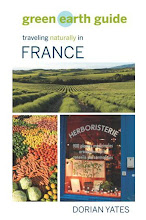
Green Earth Guide: Traveling Naturally in France
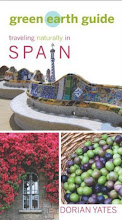
Green Earth Guide: Traveling Naturally in Spain


GREEN EARTH GUIDE: TRAVELING NATURALLY IN SWITZERLAND
by Dorian Yates • ISBN-13: 978-1-45632-363-9
• Price: $15.95 • Pages: 220 pages, paperback, 6x9
AND Kindle Edition
• Pub Date: November 22, 2010

Friday, September 17, 2010

One of the Seven MUST-Read Eco Travel books

The Green Earth Guides are listed in 7 Must-Read New Eco Travel Books - Read the full story here.

Stay tuned as I am putting the finishing touches on Traveling Naturally in Switzerland - what a country!! and I am about to enter the world of Apps! A whole new way to convey and receive information in this fast moving digital world and excellent for traveling.

I am heading to New York City next week and looking forward to visiting some of my favorite haunts like the Babycakes Bakery (I don't even like cupcakes but I dream about  theirs! Gluten-free no less), Idlewild Travel Book store - a treasure trove of good reads, and Food Liberation, a cute little health food store with an excellent gluten-free section and delicious fresh smoothies and juices.


Food Liberation, 1349 Lexington Ave (and 90th St.), NYC 10128; Tel: 212.348.2286

Friday, April 30, 2010

Eggs in Europe


Travelers from the United States may be quite surprised when they are shopping at markets and in stores in Europe to find that eggs are often not refrigerated. In fact they are often not even in cartons, but available for the picking into your own container.

At the markets in Spain you will find stacks of eggs at egg stands - brown, white, ecologico, conventional. In France, Germany and Switzerland the same holds true. Once the eggs are purchased, most people store them in their refrigerators at home, but some will leave them in a cool spot if they will be using them within a few days.

Part of the problem in the United States is that the food is often subjected to what I refer to as "shelf-life syndrome" where the focus is not on nutritional value or freshness but rather on how long the products will last on the shelves minimizing waste for manufacturers, grocers and big-box stores. As consumers, we loose, of course, since we not only get food altered to last far longer than nature intended, but we also miss out on the vitality, the richness and the beauty that fresh, local food offers.

I am afraid that eggs in the United States meet with the same fate, unless you are lucky enough to live where there are small farms, so hence they are refrigerated to help them last a long time.

When egg shopping I would err on the side of organic especially when buying room-temperature eggs since studies have shown that while all eggs run the risk of Salmonella, only about one quarter of organic and free range have the Salmonella contamination found more readily in conventional eggs, with the bonus that organic eggs have been found to contain more Vitamin E, beta-carotene and omega-3 fats with up to  a third less cholesterol than industrial-produced eggs.

Having spent time on a farm when I was a kid and later having had my own homestead-scale farm, I am familiar with the practice of storing eggs on a cool, shaded shelf especially when they will be used quickly.  I think this was, and is, customary for truly farm-fresh eggs. So don't be alarmed or put off by the piles of open-air eggs while you are traveling and be thankful for the culture of fresh.

Thursday, April 22, 2010

Thoughts on Traveling, Volcanic Eruptions and Mother Earth

Happy Earth Day - celebrate for a lifetime!


I think it is most appropriate that for the week or so preceding Earth Day that Mother Nature reminded us of her power. While travelers around the world had to deal with flight delays and cancellations as well as commerce being disrupted, the Icelandic Volcano eruption gave the world a pause. What seemed like an eternity to those stuck in airports was really just a few days in an era of constant flights when a part of the globe had a breath of no air traffic. Travel by rail swelled and some people took the cue to change their state of mind and enjoy some extra time wherever they were.

Airline companies have been complaining about how much money per day they lost and about undue flight restrictions, but all would-be travelers I have spoken with agree - as possibly inconvenient or uncomfortable having plans disrupted might be, they would rather be on the ground in one piece than 30,000 feet in the air with a frozen airplane engine - that is what most would call a no-brainer. And if the airlines are wanting to utilize the tenuous risk-assessment model, I suggest they leave that people-unfriendly calculation to the nuclear power industry (where it shouldn't be employed either), and stick to common sense as I am sure anything they have lost is still far less than what a major accident would have cost them.

In New England you learn a bit to live with the mentality of succumbing to Mother Nature. When there is a big snow or ice storm and driving is precarious, you hunker down and enjoy the respite. If you try to persevere in spite of it you usually end up in a ditch -- or worse.

Travelers, businesses and most everyone can heed the lesson and open their minds to a more creative way of looking at the world and what we are"entitled" to as a group of world citizens who feel they should be able to travel whenever and wherever they want. In this false world we have created of instant gratification, and the expectation of instant gratification, maybe we need more pauses. Maybe we should have certain weeks in the year when there is no air traffic (I can hear the screams now) and give ourselves and Mother Earth a literal and figurative breather, allowing for the possibility of changing how we treat the planet and each other.

As more of us humans lose touch with the reality of Mother Nature and her forces and are under the misguided notion that we reign supreme over the earth - think again. The Earth has been here far longer than we have and will surely be here long after we have destroyed ourselves. Whether we humans debate it, ponder it, like it or not -  the Earth does have dominion over us, not the other way around. Thank goodness.


Photo courtesy of NASA: http://visibleearth.nasa.gov/view_rec.php?id=2429

Friday, April 2, 2010

Flea Hunting In Zurich


Zurich is home to possibly the largest year round flea market (called flohmarkt in German) in Switzerland. Held every Saturday morning with maybe as few as three exceptions (see Web site for closed (geschlossen in German) Saturdays), the market is open from 8:00 am to 4:00 pm in a park at Helvetiaplatz.

In the warmer months up to 400 vendors can be selling their wares, but in the winter you can find as few as only six stalls. The winter, with the snow, cold and wind, is for the truly hale and hearty or utterly desperate.

To find the market, walk or take the tram or bus from the main train station (Hauptbahnhof). Look for tram 8 or bus 32 to Helvetiaplatz, or tram 2 or 3 to Bezirksgebaude.

Like any flea market, Zurich's offers a range of items - you can find wonderful treasures or items that should honestly be in a dumpster somewhere, but the exploring is what makes it fun.

Wednesday, March 31, 2010

Kneipping in Switzerland

The health-conscious Swiss have embraced the water cure and health philosophy of German Priest Sebastian Kneipp (1821-1897).  Kneipp (pronounced k-nipe) understood the connection between mind and body and promoted the use of medicinal herbs, exercise, a whole foods diet, a healthy mind, and his most enduring legacy –hydrotherapy. Kneipp’s book, My Water Cure, was published in 1886!

Walking barefoot through water or on wet grass, stones, or snow was one of Kneipp’s simple yet effective techniques. A thoughtful and observant man, Kneipp saw the benefits of his”cure” but also understood that each person required variations and degrees on his theme.  

There are numerous Kneipp routes and spas offering Kneipp "cures" throughout Switzerland (and Germany). At the numerous thermal baths around Switzerland you will find shallow cold water pools often between the large warm pools that you are meant to walk trough a-la Kneipp to get your circulation and lymph flowing.

You can go Kneipping or walking on a Kneippweg. In Blitzingen, south of Bern and Luzern, you can walk the NaturKneippweg through streams and meadows - it is considered to be the longest natural Kneipp path in Switzerland. 

In Grachen, a village in the Matterhorn Valley, there is a public Kneipp "garden" about a fifteen minute walk from the town with stone lined pools designed for Kneipp leg and arm immersions in cool (well let's face it- cold) water. Two hotels in the area specialize in Kneipp cures and can help you develop your Kneipping skills. These are Hotel zum See with access to the Kneipp garden as well as their own spa and the Hotel Stutz, a dedicated no-smoking hotel.

Happy Kneipping!


Monday, March 29, 2010

Abundant Natural Remedies in Switzerland


Switzerland, like much of Europe and Asia, has a long history of using natural remedies for health care. This is evident when traveling through Switzerland where drugstores and pharmacies throughout the country sell both natural and pharmaceutical products, often side by side. Switzerland is a highly developed, wealthy country complete with its own pharmaceutical giants, who would like consumers to buy their pharmaceutical products instead of long-standing, successful, natural remedies. But cultural heritage and attitudes run deep. In Switzerland, druggists and pharmacy owners must go through years of education and apprenticeship, including not only the study of pharmaceutical products but also of herbal and homeopathic remedies.

Unlike the United States where homeopathic and herbal preparations are sold in health food stores, you must buy homeopathic remedies and many herbal products in a pharmacy or apothecary – called Drogerie, Apotheke, or Farmacia. Fortunately there seems to be one on just about every street.

Natural remedies of the highest quality are made in Switzerland, Germany, France and other European countries. These natural products and medicines are displayed in pharmacy windows often with equal or greater representation than conventional products. Swiss brands include A. Vogel-Bioforce, Ceres, Weleda, and Phytomed.

In Zurich the Bellevue Pharmacy has been in operation since 1887 and stocks thousands of remedies including over 6000 homeopathic and anthroposophical medicines. Open twenty-four hours a day, all year long, you can find them in the old part of the city on Bellevueplatz by the lake.

It is a joy to travel in Switzerland (for many reasons) and have easy and abundant access to high quality natural remedies.

Friday, March 26, 2010

Fantastic Second-Hand Shopping in St. Gallen


Brockis, or Brockenhaus, are thrift shops in German and are very popular and numerous in Switzerland. As a shopper, I would recommend Switzerland as a place to peruse such shops as the merchandise is usually of very high quality. 

In St. Gallen there are a few Brockis, one of which is the Blaukreuz Brockenstube (Blue Cross thrift shop), a three-story second hand shop with proceeds going to support work on alcohol abuse and other social issues. They have an excellent selection of all manner of items including clothing, household items, furniture, books, records, movies, linens, and shoes, all at good prices. 

The have another store in Gais which is great as well but closed in the winter. The rest of the year a visit to the Gais store makes for a great excursion.


Blaukreuz Brockenstube, Turnerstrasse 20, 9000 St Gallen; Tel: 712 222 277; Web: www.blaukreuz-brockenstube.ch; open Monday to Friday from 1:30 to 6:00pm, Saturday from 10:00 am to 4:00 pm. Take the number 7 bus towards Abtwil and get off at the Vonwil stop (3 stops from the Bahnhof). Once off the bus walk in the direction the bus is going to the corner - go right and the Brockenstube is half a block down on the right. For the store in Gais take the Appenzeller Bahnen (train) to the Zweibrucken stop. Happy hunting!

Wednesday, March 24, 2010

Booklovers Delight - Rare Books in St. Gallen

Being an extreme book lover, I find the crowning site in St. Gallen, Switzerland to be the Abbey Library. The library, tucked in behind the cathedral, is a work of art unto itself. Upon entering you must slip on giant felt slippers over your shoes to protect the inlaid wood floors. The Baroque-style library has a magical quality to it, filled with treasured handwritten and illustrated books dating from as early as 500 AD. Allow plenty of time to feast your eyes on the extraordinary illuminated manuscripts and imagine the monks tonguing their paintbrushes. The Cathedral and Abbey Library are designated as UNESCO world heritage sites. To find this gem, make your way into the old city and follow the signs for the Stiftsbibliothek. 

For divine hot chocolate and other delicacies you can go to the Chocolaterie an Kloserplatz serving local Munz-Maestrani chocolate and other goodies looking out at the cathedral. For health food eats, see the post Health Food Stores in St. Gallen

If you are unable to make the trip to St. Gallen you can now, as of the past year, view 353 of the precious manuscripts on-line at a virtual library - Codices Electronici Sangallenses (Digital Abbey Library of St. Gallen). The virtual library is continuously being updated and expanded. 


Abbey Library of St. Gall Stiftsbibliothek, Klosterhof 6D, St. Gallen; Tel: 071 227 3416; http://www.stiftsbibliothek.ch; Open Monday-Saturday 10:00 am to 5:00 pm, Sunday 10:00 am to 4:00 pm; closed in November. Entry: 10 CHF.
Chocolaterie an Kloserplatz, open Monday from 1:00 to 6:30 pm, Tuesday to Friday from 9:00 am to 6:30 pm, and Saturday from 9:00 am to 5:00 pm.

Monday, March 22, 2010

Health Food Stores in St. Gallen Switzerland


The city of St. Gallen in the northeast corner of Switzerland, east of Zurich is a delightful small city. It has much to offer including interesting museums and wonderful hiking trails in and all around the city. It also has a bustling old center lined with cobblestone streets that are for pedestrians only.

St. Gallen has some wonderful health food stores all conveniently located in and near the old area. One block from the train station you can find the bright, airy Yardo, filled with a variety of foods from produce, meats, dairy, dry goods and personal care. They also have a salad bar café for lunch. Muller Reformhaus, a chain of stores in northern Switzerland, has two locations in St. Gallen, one a few blocks from the train station and the other in the heart of the old city. These stores are smaller than Yardo but also have a good selection especially the store on Spisergasse in the old city. Stadtladen is a gem tucked into a side street across from the Marketplatz, also filled with everything you could need. If you are in need of gluten-free (glutenfrei in German), Yardo and Muller have the best selections.

Some of my favorite items in these stores are the creamy organic sheep yogurt and the dried salmon jerky (great for travel food). You can also find a full range of natural cosmetics and body care products and some unusual organic Swiss wines.

For more information about the stores and a map of locations see the Green Earth Guide: Traveling Naturally in Switzerland: St. Gallen Health Foods Stores Map at the Traveling Naturally Web site.

Thursday, December 31, 2009

Green Travel Bags for the New Year


It is getting easier all the time to make environmental choices when purchasing items as companies get increasingly creative with incorporating recycled materials into their products. If you are in the market for green luggage and packs, you are in luck. Heys and Osprey are two such companies specializing in travel gear.

Heys, a Toronto based company, has been making innovative luggage for over twenty years. They have two green choices in their luggage line. The sturdy EcoOrbis rolling suitcases are made from 100% recycled ABS plastic. These come in four colors (red, black, lilac and beige) in three standard sizes and have 360º wheels and an aluminum handle. Their EcoTex line is made from recycled water bottles and includes duffle-style and accessory bags.

Heys International ships only in Canada. Heys USA ships to customers in the U.S. At Heys USA you can search by state to find stores that carry the Heys bags. In the U.S. EcoOrbis luggage is called EcoCase. The EcoCase is available in more colors and has a different embossed design on the exterior, but the bags like their Canadian counterparts are made out of 100% recycled ABS plastic.

Osprey packs, makers of excellent backpacks in all shapes and sizes, make a line of day-pack and accessory bags out of 100% recycled PET plastic. Their ReSource line uses recycled content in the mesh pockets, binding tape, webbing, buckles and zipper pulls in addition to the overall bag fabric with a commitment to using at least 70% recycled materials in the bags. This means that while the fabric is 100% recycled material, other components of the bags like the spacer mesh may only be 55% recycled material.

These bags made from recycled materials provide great options for the eco-traveler. We can hope that the future will bring  even more options for  ecological products and conscientious travel. Happy New Year.


Monday, December 14, 2009

Toilets and Traveling


I consider myself relatively easy going about toilets and bathroom facilities. That is I have gone backwoods camping and once lived with nothing more than an outhouse for almost four years. So it is not that I require luxury. However, when traveling I am amazed at the state of some toilettes.

I have gotten used to traveling with a package of tissues as I often come upon toilets without any toilet paper – and for that matter sometimes with no seat or even toilet! In some Italian, French and Spanish public toilets you will find the toilet paper in a common hallway, not in the stalls, and mere holes in the floor as toilets. These are not so bad as long as you have your squatting muscles in shape and have remembered to gather your toilet paper prior to entering your stall.

It is the urine saturated sticky floors, with used paper and towels stuck in various places, and unflushed toilets full of merde that send me in to winces and shivers. No one is caring for these bathrooms. 

So when I come upon toilets where you have to pay, and others are grumbling about the audacity of charging for urination, I am delighted to find clean, well-tended bathrooms. I would rather piss on the grass or by a tree anytime than go into the gross, urine and feces saturated cesspools that are often available.

In Spain most toilets are free, or free to customers. Do not be surprised, especially in southern areas, if you see people (admittedly usually men) peeing in the street, or by a dumpster or park tree. I would not recommend this since it only adds to the eau-de-pee often wafting from certain side streets.

I am told that in Paris this will get you a hefty fine. Fortunately in France you have a selection of toilettes - both free and fee. Many of the train station bathrooms charge .50 to 1 euro for entry. You can pay more for a shower if you are in need.

In London, many train stations charge for toilet use, but free ones can be found at most department stores and at the Covent Garden Market. 

Not surprisingly, Swiss bathrooms are notoriously clean. At the Zurich main train station you pay 2 Swiss francs for the toilets, but let me tell you it is worth it – you could perform surgery in those restrooms of gleaming marble. In Germany toilets also are generally very clean.

I am afraid that Italy does not share the same reputation as Switzerland and Germany, in fact quite the opposite. But look for fee-to-pee toilets at train stations, and also make sure you make use of the facilities at any cafe or museum you are patronizing.

In most European countries you can get by with asking for the toilette or WC. In Spain you will also see signs for Aseo. 

There are many helpful and funny links in cyberspace about bathrooms. A very comprehensive site is the Bathroom Diaries where you can search over 120 countries for bathroom locations and commentary - WOW! 

Visitors to Paris may want to part with 3 euros and download the Paris Pause Pipi Guide offering a useful guide to the public Sanisettes in Paris.There are also numerous links to Paris specific toilets with two especially good ones at Slow Travel and Colleen's Paris.

And for those who want to be prepared no matter what, you can try the new German invention Roadbag pocket urinal for men or the Ladybag  for women.

Monday, November 23, 2009

Biodynamic Farm and Farmstand in Appenzell Switzerland


If you are in Switzerland, a visit to the Appenzell canton of Northeast Switzerland, a region known for its beautiful farm land, progressive health laws, and rural traditions, is highly recommended. There are countless farms and fabulous “Wanderweg” hiking trails throughout. A favorite farm and farm store is in Gais, but if you don't know it's there, you wouldn't be likely to find it.

From the city of St. Gallen, you take the Appenzeller Bahnen, a small, red train which, as its name implies, travels through the Appenzell canton with trains running about every 30 minutes. Take this train for about half an hour to the town of Gais. (If you are in Teufen, Gais is about half-way to Appenzell on the train.) Once off the train, you will walk about 1 mile. Cross Schulhausstrasse and walk along Zung St., then cross Stossstrasse and slightly to the right of where you have been walking will be Kehr St. Walk on Kehr for about one-quarter to one-third of a mile and take a right onto Bommes Road – looks more like a driveway - within 20 yards or so you will walk into the yard of the Biodynamic Hofladen Farm where there is a little farm store. Biodynamic Hofladen Farm, Bommes 3, Gais, Tel: 71 793 37 85; www.hof-bommes.ch

The store’s entry-way has fresh organic produce delivered on Fridays. Further inside you will find a mini-health food store with organic and free-trade food and treats, including farm fresh, biodynamic dairy products from the Hofladen Farm. There is nothing quite like farm fresh yogurt in a glass container – seems from a lost world - perfect and delicious (my apologies to non-dairy eaters.) Fresh, organic spelt bread, made from spelt grown a few towns over (a bakery that makes their own spelt pasta, pastries, and bread - directions on their Web site), is delivered Tuesday, Fridays and Saturdays. On those days the Hofladen store is open from 9:00 to 11:30 am and then again from 3:00 to 7:00pm. Every other day it is open from just 6:00 to 7:00pm.

Not much English is spoken, but everything seems to get across just fine. Two tips: In Switzerland (and many other places in Europe), when buying fresh produce you are responsible for weighing and pricing it. There is a number by the name of the item – e.g. Red Cabbage #62 – take your red cabbage over to the scale (somewhere in the produce area) and weigh it – you will need to punch in that number. A sticker will spit out with the weight and price that you apply to the bag or item. In lower-tech establishments, you may have to write it on the bag.

Also, remember to bring your own bags – many stores either do not have bags or charge for them, and often they are flimsy – so just get used to having a stash of canvas bags rolled up in your daypack.

The farm belongs to the Langenegger family. The grandmother, Lilly Langenegger, is a local famous artist who writes children’s books with beautiful illustrations of traditional Swiss rural images and Appenzeller farm life. The books are available in German, English and French. Pictures and purchasing information are available at the publisher Web site (in German, but translatable).
Enjoy.

Sunday, January 20, 2008

Switzerland - A week at the Paracelsus Clinic


19-01-08
Switzerland was a delight as usual. I walked miles and miles everyday – up and down – like the goats and sheep. Many hours a day this week were spent doing tests or treatments at the Paracelsus Biological Medicine Clinic in Lustmuhle Switzerland, about one and a half hours east of Zurich.
This is my fourth time at the clinic so I am very used to the routine. I had an intravenous infusion everyday – either an alkalizing mixture filled with vitamins, minerals and various natural, homeopathic remedies, or an ozone infusion which is cleansing to the blood and also has natural remedies. I also did a type of detoxifying body work called MRT for Matrix Regeneration Therapy, a tissue cleansing treatment done on the back that is sort of like Chinese cupping, but with some added features. I also did one of the oxygen therapies they offer. Usually I ride a stationary bicycle while breathing oxygen. This is energizing and makes me feel the closest I probably ever will to Lance Armstrong since I do not get tired or muscle fatigued with the oxygen. This time, I did a passive oxygen therapy, new to me, that involves just sitting for twelve minutes breathing in oxygen that is charged with negative and positive ions, based on research by a Dr. Engler who found this to be very helpful in oxygenating the body. I received injections with various natural remedies for my thyroid, adrenals, and had a number of tests to check hormones, heavy metals, infections, and general health.
I met lovely people – about eleven other Americans were there while I was, one of whom I knew from a previous trip and the others became fast friends as everyone bonded discussing treatments, doctors, and health issues, not to mention life in Switzerland.
I was the most familiar with the area since I have been there before, so I went off in the afternoons, either walking, or to the nearby small city of St. Gallen.
The beauty of Switzerland is that it is like being in Vermont except with the most efficient public transportation probably on the planet. From the clinic, I could walk down the hill – less than five minutes - to a train stop and take the train, arriving in St. Gallen in about eight minutes.
I have my favorite haunts in St. Gallen including the Brockenhuas (German for second-hand store) where I bought two luxurious, silky cotton, Swiss made duvet covers for about $7 each, knowing that new they cost between $200-300 each!
I know every health food store in the city – of which there are five, not including the two major supermarkets which also sell organic and natural products. I enjoyed going to all of them, buying delicious Swiss sheep’s milk yogurt, a little fair trade dark chocolate with a hazelnut filling to die for, some goat cheese and gluten-free bread made with corn and buckwheat, as well as some Italian oranges.
Some great things I found this trip:
• The first Licensed Organic Trout Farm in Switzerland - Mia’s Bio-Forellenzucht, Haupstrasse (Main Street) 62, Niederteufen; Tel: 079-655-8370 (Niederteufen
is really a neighborhood of Teufen and is between the Paracelsus Clinic and the town center of Teufen.)
• I learned from an American friend who has lived in Switzerland for six years that when you say “I am so Full” after eating, in Swiss German this means you are drunk! ☺ I learned this when I said it while out to lunch with my friend and the waitress laughed so hard – I didn’t know why until my friend broke the news to me.
• I met a woman who does nature photography – her photos can be viewed at: www.yessy.com/carolmilisen
I met another woman who works with animal sanctuaries around the world and has adopted two elephants! Explore a couple of the groups she works with at: www.elephantears.org and www.wildnet.org
I discovered Australian chocolate truffles made without gluten or milk – www.boojabooja.com
At the Zurich main train station you can BORROW bicycles for free with a 20 CHF deposit and identification, preferably a passport. Velogate, as it is called is located across from Track (or Gleis in German) 18 at Museumstrasse.
Thankfully I continued to see apothecaries and pharmacies selling natural homeopathic and herbal remedies alongside conventional pharmaceutical products.
A busy, productive week and now I am blissfully on the train from St. Gallen to Geneve, then onto Nice France!

Friday, October 5, 2007

Hidden Organic Treasures


If you are in Switzerland, a visit to the Appenzell canton of Northeast Switzerland, a region known for its beautiful farm land, progressive health laws, and rural traditions, is highly recommended. There are countless farms and fabulous “wanderweg” hiking trails throughout. A favorite farm and farm store is in Gais, but if you don't know it's there, you wouldn't be likely to find it.

From the city of St. Gallen, you would take the Appenzeller Bahnen, a small, red train which, as its name implies, travels through the canton with trains running about every 30 minutes. Take this train for about half an hour to the town of Gais. (If you are in Teufen, Gais is about half-way to Appenzell on the train.) Once off the train, you will walk about 1 mile. Cross Schulhausstrasse and walk along Zung St., then cross Stossstrasse and slightly to the right of where you have been walking will be Kehr St. Walk on Kehr for about one-quarter to one-third of a mile and take a right onto Bommes Road – looks more like a driveway - within 20 yards or so you will walk into the yard of the Biodynamic Hofladen Farm (Bommes 3, Gais, Tel: 71 793 37 85; www.hof-bommes.ch )where there is a little farm store.

The store’s entry-way has fresh organic produce delivered on Fridays. Further inside you will find a mini-health food store with organic and free-trade food and treats, including farm fresh, biodynamic dairy products from the Hofladen Farm. There is nothing quite like farm fresh yogurt in a glass container – seems from a lost world - perfect and delicious (my apologies to non-dairy eaters.) Fresh, organic spelt bread, made from spelt grown a few towns over (www.dinkel-stein.ch - they make their own spelt pasta, pastries, and bread - directions on their web site), is delivered Tuesday, Fridays and Saturdays. On those days the store is open from 9-11:30 am and then again from 3-7pm. Every other day it is open from just 6-7pm.

Not much English is spoken, but everything seems to get across just fine. Two tips: In Switzerland (and many other places in Europe), when buying fresh produce you are responsible for weighing and pricing it. There is a number by the name of the item – e.g. Red Cabbage #62 – take your red cabbage over to the scale (somewhere in the produce area) and weigh it – you will need to punch in that number. A sticker will spit out with the weight and price that you apply to the bag or item. In lower-tech establishments, you may have to write it on the bag.
Also, remember to bring your own bags – many stores either do not have bags or charge for them, and often they are flimsy – so just get used to having a stash of canvas bags rolled up in your daypack.

The farm belongs to the Langenegger family. The grandmother, Lilly Langenegger, is a local famous artist who writes children’s books with beautiful illustrations of traditional Swiss rural images and Appenzeller farm life. The books are available in German, English and French. Pictures and purchasing information are available at the publisher website (in German, but translatable): www.appenzellerverlag.ch/de/buch.php?IDath=15&actuel=1&asearch=3

Enjoy.