Most people don't realize that Spain, not Italy, is the largest producer of olive oil in the world. Organic olive oils are becoming increasingly available and one of the largest producers of organic olive oil in Spain is the family-run Soler Romero.
Situated in the Spanish province of Jaen in the southern region of Andalucia—the largest olive and olive oil producing area in Spain—Soler Romero uses only its own olives and does not buy from other farms or cooperatives so as to maintain the strictest control over the quality of their oil. They compost and recycle all the scraps and waste from their olive groves.
In business since 1850, Soler Romero was the first olive farm in Jaen to follow organic farming practices and was also the first to receive organic certification from the USDA in 2002. They also are certified organic by the European Union, Japan, and China as well as the local organic certification area for the region of Andalucia.
The estate's more than 1500 acres produce 700,000 pounds of olive oil every year from the picual olive variety, high in antioxidants, which makes the oil stable. Every stage of the process is performed on the estate, including processing the olives within two hours of harvest making for a very low-acidity oil— 0.10 percent (to be considered extra virgin an oil must be below 0.80 acidity). Soler Romero chooses an early harvest time, between mid-October and mid-November, which they feel results in the perfect oil made with ideally ripened olives.
Soler Romero olive oil is available in Spain, and also in the United States as well as other countries—including the UK, Canada, the Netherlands, Russia, Japan, China and Korea. If you live in Portland, Oregon (or are visiting) you can find Soler Romero oil served at Higgins Restaurant. Badger organic health balms and creams uses Soler Romero organic oil in their organic body-care products.
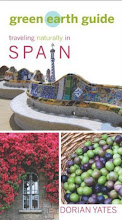
For more information about Spain's organic olive oils see the Green Earth Guide, Olive Oil: An Olive Oil Lover's Guide to the Organic Oils of Spain, with listings of forty organic oils and tips on having olive oil tastings. Use the Guide to help you tour through olive groves and estates, sampling Spain's liquid sunshine as you travel through Spain.
Wednesday, June 29, 2011
Friday, June 10, 2011
Local and Organic Table in Dublin Ireland
The Farm—the name conjures a bucolic scene with hay and fences—but this farm is in the heart of downtown Dublin near Trinity College and Grafton Street. The outside of The Farm is unassuming with a sandwich-board announcing the day's specials. Inside, rather than rustic, worn-pine tables and chairs, you will find a seemingly upscale restaurant with white cushioned chairs. Don't be fooled by the decor. The Farm lives up to its name, serving fare made with local and organic ingredients. The Farm burger is made with organic Irish beef, topped with cheddar cheese, organic bacon and a side of salad or fries. Other meats offered include free-range chicken, organic salmon and duck. Vegetarians can enjoy a variety of dishes and diners looking for gluten-free choices will happily find a number of potato options (it is Ireland after all).
The Farm also offers organic wines and has one of my favorite Spanish wines from the Aranleon Bodega. On our evening there we enjoyed delicious duck, beef, goat cheese, salads and some mighty fine fried potatoes.
The Farm is conveniently located with generous hours—a great place to take a load off of tourist-treading, weary feet and to nourish hungry bellies with organic and local Irish victuals. Prices for starters range from 6 to 10 euros, entrees from 16 to 27 (the highest end for organic sirloin steak).
The Farm, 3 Dawson Street, City Centre South, Dublin 2; Tel: 01 671 8654/8323; open 7 days from 11:00 am to 11:00 pm.
Saturday, June 4, 2011
Finally! A Portable Glass Water Bottle
My choice of portable water bottle is a perpetual conundrum for me.
Plastic has the longest list of undesirable features. For starters I honestly can't stand the taste of water sitting in plastic. Then, beyond taste, there is the issue of the plastic chemicals leaching into the water causing all sorts of potential health problems. While bisphenol-a (BPA) is the newest culprit on that list, the issues of plastic-leaching containers has been around for decades. Over thirty years ago I worked for the New York Public Interest Research Group (NYPIRG) where in the early 1980s a brilliant scientist named Walter Hang (who now works for Toxics Targeting) released a ground-breaking report about HDPE plastic (commonly used in one-gallon water jugs and milk containers) leaching into water and milk. While true that harder plastics seem to leach less than softer plastics, the recent BPA reports have shown that all sorts of plastics have potential problems. As if that weren't enough, there is the perennial predicament of the environmental consequences of plastic manufacturing and disposal. So while plastic bottles are light and seemingly easy, they fail as a good choice on many other counts.
The next light-weight option is aluminum. I do not use aluminum cookware or anti-perspirants made with aluminum—any substance that might contribute to my already challenged memory I try to avoid as best I can. So needless to say, sipping water from an aluminum bottle is not high on my list.
Then there is stainless steel, or at least what we are told is stainless steel. Some may say I am too picky, but I suspect that a lot of what is sold as stainless steel is not, but rather mixed with metals that I would rather not be drinking from. That, coupled with the metallic taste, makes stainless steel a tempting but non-option for me.
This leaves me with glass or gourds. Sadly, gourds are not practical. Glass would be perfect were it not for it being heavy, highly breakable, and difficult to find the correct bottle shape for both drinking and cleaning (that is, wide enough to clean, but narrow enough to drink from comfortably without dripping everywhere).
You can see why walking out of the house (or lodging when I am traveling) with a water bottle poses such a dilemma for me.
I am happy to report that I have found the answer to my quandary. Based in neighboring Portsmouth, New Hampshire, the Bamboo Bottle Company has designed a water bottle comprised of glass, BPA-free plastic and bamboo.
This is how it works. The actual bottle is made of sturdy glass (made with 51% recycled glass) which can hold hot or cold beverages— a huge advantage over plastic. The mouth of the bottle meets my requirements—wide enough for easy cleaning, while appropriately-sized for dripless drinking. The BPA-free plastic provides the nuts and bolts of the bottle, keeping the glass in its protective and insulating bamboo casing. The components disassemble for cleaning—you can hand wash the glass bottle or put it in a dishwasher (the plastic parts can go in the dishwasher as well, but keep the bamboo sleeve out of the machine and even the sink—simply wipe clean with a damp cloth for the longest life).
The Bamboo Bottle holds just over a pint (16 ounces) of liquid and has a thermos-like feel to it. With the top on, the bottle is 10.25 inches tall and 3 inches in diameter, just making the size-cut for my small hands.
No plastic or metallic after-taste or leaching—check. No exposed, breakable glass—check. Reusable, low-impact materials with a long-life span—check. While close to perfection, I do hold out hope that some day the plastic parts can be made from a sustainable, non-polluting material (the company says they are aiming for plastic-free in the future). Until then, I will be happy with my Bamboo Bottle and cross the search for the perfect water-bottle off my to-do list.
Plastic has the longest list of undesirable features. For starters I honestly can't stand the taste of water sitting in plastic. Then, beyond taste, there is the issue of the plastic chemicals leaching into the water causing all sorts of potential health problems. While bisphenol-a (BPA) is the newest culprit on that list, the issues of plastic-leaching containers has been around for decades. Over thirty years ago I worked for the New York Public Interest Research Group (NYPIRG) where in the early 1980s a brilliant scientist named Walter Hang (who now works for Toxics Targeting) released a ground-breaking report about HDPE plastic (commonly used in one-gallon water jugs and milk containers) leaching into water and milk. While true that harder plastics seem to leach less than softer plastics, the recent BPA reports have shown that all sorts of plastics have potential problems. As if that weren't enough, there is the perennial predicament of the environmental consequences of plastic manufacturing and disposal. So while plastic bottles are light and seemingly easy, they fail as a good choice on many other counts.
The next light-weight option is aluminum. I do not use aluminum cookware or anti-perspirants made with aluminum—any substance that might contribute to my already challenged memory I try to avoid as best I can. So needless to say, sipping water from an aluminum bottle is not high on my list.
Then there is stainless steel, or at least what we are told is stainless steel. Some may say I am too picky, but I suspect that a lot of what is sold as stainless steel is not, but rather mixed with metals that I would rather not be drinking from. That, coupled with the metallic taste, makes stainless steel a tempting but non-option for me.
This leaves me with glass or gourds. Sadly, gourds are not practical. Glass would be perfect were it not for it being heavy, highly breakable, and difficult to find the correct bottle shape for both drinking and cleaning (that is, wide enough to clean, but narrow enough to drink from comfortably without dripping everywhere).
You can see why walking out of the house (or lodging when I am traveling) with a water bottle poses such a dilemma for me.
I am happy to report that I have found the answer to my quandary. Based in neighboring Portsmouth, New Hampshire, the Bamboo Bottle Company has designed a water bottle comprised of glass, BPA-free plastic and bamboo.
This is how it works. The actual bottle is made of sturdy glass (made with 51% recycled glass) which can hold hot or cold beverages— a huge advantage over plastic. The mouth of the bottle meets my requirements—wide enough for easy cleaning, while appropriately-sized for dripless drinking. The BPA-free plastic provides the nuts and bolts of the bottle, keeping the glass in its protective and insulating bamboo casing. The components disassemble for cleaning—you can hand wash the glass bottle or put it in a dishwasher (the plastic parts can go in the dishwasher as well, but keep the bamboo sleeve out of the machine and even the sink—simply wipe clean with a damp cloth for the longest life).
The Bamboo Bottle holds just over a pint (16 ounces) of liquid and has a thermos-like feel to it. With the top on, the bottle is 10.25 inches tall and 3 inches in diameter, just making the size-cut for my small hands.
No plastic or metallic after-taste or leaching—check. No exposed, breakable glass—check. Reusable, low-impact materials with a long-life span—check. While close to perfection, I do hold out hope that some day the plastic parts can be made from a sustainable, non-polluting material (the company says they are aiming for plastic-free in the future). Until then, I will be happy with my Bamboo Bottle and cross the search for the perfect water-bottle off my to-do list.
Labels:
blogsherpa,
Eco travel,
FRANCE,
GERMANY,
Green travel,
hiking,
ITALY,
responsible products,
SPAIN,
Switzerland,
trash reduction,
UK,
USA,
water
Tuesday, May 3, 2011
Organic Burgers in New York City


Hankering for an organic hamburger in New York City?
You can find the largest variety of organic burgers in New York at BareBurger, with two locations in Manhattan, one in Queens and one opening in Brooklyn this summer. BareBurger's generous menu includes many foods that are 100% organic and they are good about making the appropriate distinctions between organic, natural and grass-fed. BareBurger serves meat, vegetarian and vegan burgers, as well as other dishes. 100% organic meats are beef, bison, sausage, and the vegetarian burger and vegan portobello mushroom burgers are 100% organic. Pasture-raised, hormone- and antibiotic-free meats are elk, ostrich, lamb, chicken, and bacon. All the cheeses served are rBGH-free (growth hormone-free), three of which are 100% organic. All the milk, butter, eggs and ice cream are 100% organic as well, making for some fine old-fashioned tasting milkshakes. The meats at BareBurger come from New York, New Jersey and Pennsylvania, with the exception of the bison and elk which come from Montana. They offer a few bun options and for people needing to avoid gluten, they offer a lettuce-wrap (100% organic!). Peanut allergy sufferers take note: the french fries are cooked in peanut oil.
The Green Table, tucked in the middle of Chelsea Market, the renovated former Nabisco biscuit factory on West 15th Street, specializes in organic and local foods from area farmers. They serve organic meat as well as organic vegetables and beverages. The farms they purchase from include Hawthorne Valley Farm, a biodynamic farm in upstate New York, Flying Pigs Farm, Old Chatham Sheepherding, and many others. The beef for Green Table's burgers comes from Wrighteous Organics in Schoharie NY about 175 miles north of the city and is distributed by Dickson's Farmstand Meats, an organic and natural butcher a few doors down from The Green Table in Chelsea Market.
Local Food Lesson Learned: one of my traveling companions wanted to trade out the spicy tomato chutney and fresh kim chi served with the burger for lettuce and tomato—not possible, at least not in April. Since The Green Table specializes in local and seasonal fare, fresh tomatoes are not available this time of year in New York. Even though it made my companion a little grumpy, I was delighted at this clear ideological line. As consumers we have gotten used to having what we want, whenever we want it (like an organic hamburger in New York City). Fresh, young spring greens were served with the burger and my friend had the chutney on the side. The rest of us enjoyed the kim chi (crunchy and fresh, not long-fermented) and the tomato chutney slathered over our burgers resulting in savory, spicy, perfectly cooked burgers. Vegetarians can find a number of organic dishes at The Green Table too.
And while we are talking about organic milkshakes, if you are visiting the Metropolitan Museum (5th Avenue and 82nd Street), you will be delighted at the relatively new food concession stand/van parked outside. Cake and Shake serves up cupcakes, savory cakes and milkshakes made with organic ingredients (if you can not eat cow-dairy or wheat/gluten, I am afraid there is nothing for you to enjoy), open seven days a week.
The Green Table, Chelsea Market, 9th Avenue between 15th & 16th Streets, New York; Tel: 212 741 6623; open Monday to Wednesday 11:30 to 9:00 pm, Thursday & Friday 11:30 to 10:00 pm, Saturday 11:00 am to 10:00 pm, Sunday from 11:00 am to 4:00 pm.
BareBurger, 535 Laguardia Pl. (south of Washington Square Park between Bleeker and W. 3rd St. on the edge of NYU) Manhattan; and 514 Third Avenue (between 34 & 35th Streets), Manhattan; open 11 am to 11 pm, till midnight on Friday and Saturday and open at 10 am on Saturday and Sunday; and 33-21 31st Ave, Astoria, Queens; and coming in the summer of 2011—Park Slope, Brooklyn.
Subscribe to:
Posts (Atom)