Tuesday, April 28, 2009

Countdown to Release Day - One Week!


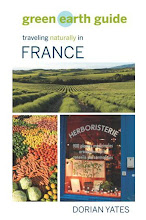
As the Car Talk brothers like to say, this is the "shameless commerce" blog entry with the Countdown to Release Day - One week until Tuesday May 5th when the first Green Earth Guide hits bookstores and online booksellers. The booksellers I have talked to are excited about stocking the book and I can only hope that readers will be as thrilled to have it.

One little heads-up if you are ordering through Amazon.com. If you choose the free shipping option, they say the book will not ship until May 11th. If you choose the "standard shipping" option, it ships on the release day - May 5th - in other words, the free shipping orders get put on the back-burner until the people paying for shipping get their orders.

For a couple of corrections (yes, even in this day of digital and expert proofreading, a couple of mistakes make it into print), please see the page devoted to the Green Earth Guide: Traveling Naturally in France on the Traveling Naturally Web site, www.travelingnaturally.com.

I hope everyone finds the book helpful, informative, and interesting as they plot their travels through France.

Sunday, April 5, 2009

Packing


I have been having a bit of a love affair with Bellcaire d’Emporda. My view of the town, surrounded by what will be fields of sunflowers in a few months, from the restored stone Masia I have been living in for the last three months is magnificent at every time of day. The old castle at the center of the town is perched on a bit of a hill, and the sun gleams yellow and gold on the village most days. I can bike or walk to the village and get really everything I need there - fresh food of every kind, from meat, fish, goat dairy, fruits, vegetables, wine, newspapers, and chocolate!

People are friendly, and the lovely woman who runs the local bar and café knows to bring me an aqua con gas con limon (sparkling mineral water with a lemon) when she sees me walk in the door.

I have become very partial to this little medieval village that sits about six kilometers southwest of L’Escala, a fishing village turned tourist town, on the Mediterranean.

As I start to organize and pack my belongings, getting ready to return to Vermont after a winter in Spain, I am thinking about storing up inside of me all the deeply satisfying moments here in this house and village - bike rides with the wind in my face, smelling the divine fragrance of a clover-like crop used to nourish the soil; warm sun soaking into my skin in February and March; lavender plants by the score, olive trees, and almond blossoms; my own little orange tree, which clearly knows it is loved by its show of profuse new growth; funny and profound conversations with my fourteen year old son; delicious fresh food for dinner every night; meeting new people who are open and kind, funny and beautiful, some of which are only brief encounters like the darling older Spanish man at the café in the train station with his weathered face exclaiming when he heard I was from the Estados Unidos (United States), “Bush es muy mal! Muy mal para el todo mundo.” (Bush is very bad! Very bad for the whole world.); old stone villages and houses; green, green, and more green; and reconnecting with dear old friends, and making new ones.

At the beginning of my time here, three months sounded like it was going to be so long. Now that I am at the end, there is so much I haven’t done that I wanted and hoped to do. Time -- what an amazing thing - different every day - fast, slow, unpredictable. And here it is, three months later, and I am packing my bag, trying to make room for a little olive oil and a few small containers of the local anchovies, like none I have ever tasted before. And bringing home the hope that I can return for more of this country that I have grown to love deeply.

Wednesday, March 4, 2009

Santiago de Compostela


A good way to ruin a nice city is to try driving in it at rush hour, which is just what I had to do in Santiago. Between having a small inadequate map and hitting rush hour, I spent over an hour driving around congested Santiago trying to find the train station, which I had assumed, as had the rental car clerk, would be well signposted, but not so.

Once the car was returned (an adorable 2-door Citroen that got incredible mileage), I was able to hoof around Santiago and see the main sites, which were about the only part of Santiago I had not yet seen from the car. The cathedral sits on an impressive, massive Praza (the Galicians say Praza instead of Plaza) de Obradoiro where all “caminos” to Santiago converge. It was virtually empty on the February evening when I was there, but I could imagine it filled with throngs of all sorts of pilgrims in the warmer months. It was sort of thrilling to think of the thousands of pilgrims for centuries who have landed on that square.

I found a health food store and bought some fruit for my train journey back east and wandered around the city until it neared my 10:00pm train departure time.

The overnight train from Santiago to Madrid was possibly one of my most uncomfortable nights I have ever spent. I think the car I was in came out of some dead train-car storage facility by some mean-spirited train personnel. The seats were not designed to recline, nor did they have movable armrests so I was stuck with a hard-edged metal arm rest in the middle of the two seats so even though I was lucky enough not to have anyone sitting next to me I could not curl up and lay cross ways on the seats without metal objects jabbing me at every turn. This as a head’s up to travelers – it may be worth springing for the extra 50 euros for the berth if you are making that journey.

Galicia's magnificence


It was spring in Galicia and people were out with their hoes, spades, pitchforks and carts tilling the deep dark rich soil that has supported them for millennia. Horreos, ancient stone structures used for storing the harvest – corn, potatoes, and more- dot every village. Galicia is truly spectacular – somewhat of a well-kept secret which is probably its saving grace. It is easy to gasp at every turn in the road, as the coast is stunning, and the hillsides pastoral.Fortunately, the laws around development are strict in this region of Spain, particularly in Carnotta which boasts a 7 km long white sand beach, the longest in Galicia.

The land is full of ancient history and Celtic myths. The northwest has some lesser traveled routes to and from Santiago de Compostela. One of these is to Finisterre (Fisterra in Galician) which means lands end, and it sits on a peninsula at the end of that part of Spain, with the Atlantic Ocean crashing around the rocks at the bottom of the mountain. This was my pilgrimage, not Santiago. The beach as you approach Fisterra seems like heaven, and must have certainly seemed so to any pilgrims making their way through the spiny gorse and forest paths. Turquoise green water and white sand stretching for two kilometers, it is littered with shells, many of which are like the shell symbol that marks the way to Santiago.

Another leg of the camino is between Fisterra and Muxia, also breathtaking. And for me quite literally as Muxia is not immune to a common ill I have found in Spain – one or two signs for an invisible tourist information office. So I headed off in the direction of the hill with the rocks and churches, but the route I ended up on was a real cliffhanger – truly – the path, marked with little painted white arrows, pointed up along a string of cement-glued stones to the rock face to be used as hand and foot holders. The day I was there the wind was blowing a gale and as I was trying to scale the cliff I kept having different newspaper headlines flashing in my mind, “middle aged woman blows off rocks.” “Middle aged woman tumbles to death at sanctuary.” Between the wind and the vertical pitch I was working hard and I kept thinking, “Can this really be the only way up here?” Of course it is NOT. I was on the thrill seeking, youthful pilgrim route. Once at the top with the boulders and a single stone cross, I found the new stone-lined gentle descent down toward the Sanctuario de Barca and the crashing sea. From there a lovely promenade follows the bay line back to the parking and village.

Between the spectacular ocean and the windmills lining every ridge, Galicia seems like a green traveler's delight.